

Food preservation has always played a central role in agriculture, food processing, and commercial kitchens. However, today’s fast-growing demand for longer shelf life, hygienic processing standards, and value-added food products has made traditional drying methods less reliable. Businesses and entrepreneurs now require smarter solutions that improve productivity while protecting food quality. This is where a stainless-steel dehydrator machine becomes an essential investment.
Whether you operate a small food startup, manage a commercial kitchen, run a spice-processing unit, or work with farmer-producer groups, a professional food dehydrator machine helps convert fresh produce into shelf-stable, high-quality ingredients without compromising nutrition or taste.
Modern dehydration technology supports consistent drying performance across fruits, vegetables, herbs, and specialty food materials, helping businesses reduce wastage and unlock new income opportunities through value-added processing.
Why Food Dehydration Is Becoming Essential in Today’s Processing Industry
Across India and globally, food processors are shifting from traditional sun drying to controlled hot-air drying systems. Weather uncertainty, contamination risks, and inconsistent drying results have encouraged businesses to adopt stainless-steel food dehydrator equipment that ensures predictable output and hygienic operation.
Using modern food dryers helps processors:
- Reduce post-harvest losses significantly
- Improve storage stability of seasonal produce
- Preserve flavor, color, and nutrients
- Enable year-round processing capability
- Support packaged food production businesses
- Improve supply chain flexibility
- Maintain hygiene during drying operations
Instead of relying on climate conditions, dehydration machines allow precise control over temperature and airflow, ensuring uniform moisture removal across every tray.
Understanding How a Food Dehydrator Machine Works
A professional food dehydrator machine operates using controlled hot-air circulation that removes moisture from food products gradually and evenly. This process prevents overheating and maintains structural integrity while extending shelf life naturally.
Inside the drying chamber:
- Warm air flows evenly across trays
- Moisture evaporates gradually
- Nutrients remain preserved
- Color retention improves
- Product shrinkage stays controlled
This balanced drying approach makes modern fruit dehydrator systems suitable for both delicate ingredients like herbs and dense products like root vegetables.
The Role of Stainless-Steel Construction in Hygienic Food Drying
Food safety is a major concern in modern processing environments. Equipment material directly impacts hygiene levels and long-term machine durability. Stainless-steel vegetable dryer machine systems offer strong resistance to corrosion while supporting easy cleaning and maintenance.
Advantages include:
- Food-grade surface compatibility
- Long operational lifespan
- Temperature resistance stability
- Reduced contamination risks
- Easy sanitation between batches
- Reliable structural strength
This makes stainless-steel food dryers ideal for commercial kitchens, agricultural processing units, institutional facilities, and packaging businesses.
Applications of a Dehydrator Machine Across Multiple Industries
Modern dehydration technology supports a wide variety of industries and production setups.
Fruit Processing Businesses
A professional fruit dehydrator helps produce:
- Banana chips
- Mango slices
- Apple rings
- Pineapple cubes
- Papaya pieces
- Citrus peels
These products can be packaged for retail sale or used as ingredients in bakery and snack production.
Vegetable Processing Units
A stainless-steel vegetable dryer machine supports dehydration of:
- Onion flakes
- Garlic slices
- Ginger chips
- Tomato flakes
- Spinach leaves
- Beetroot slices
These ingredients are widely used in packaged foods and ready-to-cook products.
Spice and Herb Processing
Many herbs lose quality during traditional drying. Controlled dehydration ensures safe processing of:
- Curry leaves
- Mint leaves
- Coriander leaves
- Tulsi leaves
- Medicinal herbs
- Turmeric slices
A hygienic food dehydrator machine protects aroma and medicinal value during drying.
Commercial Kitchens and Cloud Kitchens
Restaurants increasingly depend on dehydration systems to preserve ingredients in advance and improve workflow efficiency.
Benefits include:
- Reduced daily preparation time
- Ingredient shelf-life extension
- Consistent recipe quality
- Reduced storage dependency
Farmer Producer Organizations and Rural Entrepreneurs
Agricultural cooperatives benefit greatly from adopting food dryers for value addition.
Instead of selling raw produce at lower prices, farmers can process:
- Dried vegetables
- Packaged fruit snacks
- Herbal products
- Spice ingredients
This increases market reach and profitability.
Choosing the Right Capacity: Matching the Machine to Your Workflow
Selecting the correct dehydrator machine capacity ensures smooth production planning and operational efficiency.
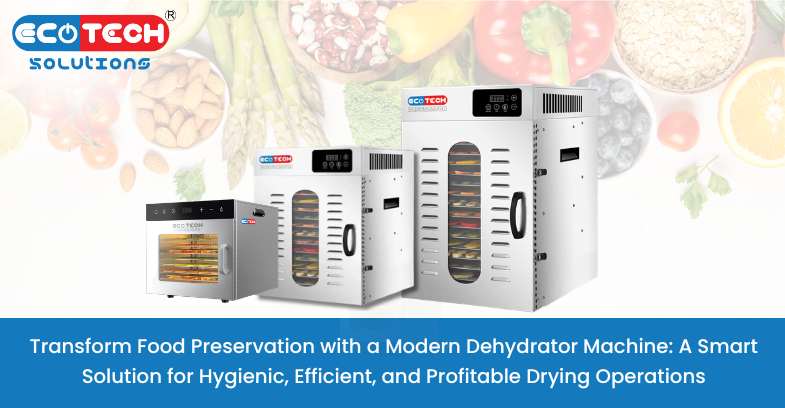
ET Solutions provides multiple tray-capacity options designed for different processing scales.
6-Tray Food Dehydrator Machine
Ideal for:
- Startup businesses
- Home entrepreneurs
- Small restaurants
- Laboratory-scale testing
- Pilot food processing units
This compact food dehydrator supports efficient drying without occupying large workspace areas.
12-Tray Stainless-Steel Food Dryer
Suitable for:
- Medium-scale processors
- Institutional kitchens
- Packaged snack manufacturers
- Herb-processing units
- Farmer collectives
The 12-tray configuration balances capacity with operational flexibility.
16-Tray Commercial Food Dehydrator Machine
Best for:
- Industrial processing units
- Agricultural export businesses
- Large kitchens
- Bulk ingredient suppliers
- Spice processing companies
This large-capacity fruit dehydrator supports consistent high-volume output with uniform airflow distribution.
Benefits of Using a Professional Food Dehydrator Instead of Traditional Sun Drying
Traditional drying methods may appear economical but often create inconsistent results and contamination risks.
Modern food dehydrator machines offer several advantages.
Improved Hygiene Standards
Closed drying chambers protect products from dust, insects, and environmental pollutants.
Faster Drying Cycles
Hot-air circulation reduces drying time significantly compared to sun drying.
Better Nutrient Preservation
Controlled temperature prevents overheating damage.
Consistent Batch Quality
Uniform airflow ensures equal drying across trays.
Reliable Year-Round Processing
Production continues regardless of weather conditions.
Supporting the Growth of Food Startups and Value-Added Businesses
Food dehydration technology is creating new opportunities for entrepreneurs across India. A stainless-steel vegetable dryer machine helps small businesses convert seasonal produce into premium packaged products.
Popular startup product ideas include:
- Dehydrated vegetable mixes
- Fruit snack packs
- Herbal tea ingredients
- Natural seasoning blends
- Ready-to-cook vegetable kits
With increasing demand for preservative-free foods, dehydration equipment supports both quality and scalability.
Energy Efficiency and Operational Reliability in Modern Food Dryers
Energy efficiency plays a major role in long-term processing cost control. Modern food dryers are designed to optimize airflow and heat distribution, ensuring uniform drying with minimal energy loss.
Key performance advantages include:
- Controlled temperature stability
- Efficient hot-air circulation
- Batch-level production flexibility
- Reliable drying cycles
- Reduced product rejection rates
This improves production consistency and supports business profitability.
Maintaining Product Quality During Dehydration
One of the biggest advantages of using a professional food dehydrator machine is the ability to maintain product quality throughout the drying cycle.
Controlled drying helps preserve:
- Natural taste
- Aroma retention
- Color stability
- Nutritional value
- Texture consistency
These factors are essential for packaged food brands and export-ready ingredients.
Why Hygienic Design Matters in Food Processing Equipment
Food safety regulations are becoming increasingly important across industries. Stainless-steel fruit dehydrator systems support hygienic workflows through easy cleaning and contamination-resistant construction.
This ensures:
- Safe ingredient handling
- Reduced microbial risk
- Compliance with processing standards
- Better packaging compatibility
- Long-term reliability
Such features make dehydration machines suitable for both domestic and export-oriented production environments.
Long-Term Business Advantages of Investing in a Dehydrator Machine
Choosing the right dehydrator machine supports operational efficiency and opens new product opportunities.
Business benefits include:
- Reduced storage challenges
- Lower spoilage losses
- Improved supply stability
- Increased product shelf life
- Expanded product portfolio
- Higher market value for processed foods
As consumer demand for natural preserved foods continues growing, dehydration technology becomes a strategic processing investment.
Why ET Solutions Food Dehydrator Machines Support Reliable Processing Performance
ET Solutions designs stainless-steel food dehydrator machines to support durability, hygienic operation, and consistent drying performance across different processing scales.
Available tray configurations allow businesses to select equipment that matches their production capacity, whether they operate small kitchens, medium processing units, or large agricultural facilities.
Reliable airflow engineering and sturdy stainless-steel construction ensure that these machines perform efficiently across a wide range of drying applications.
Frequently Asked Questions (FAQs)
A dehydrator machine removes moisture from food products using controlled hot-air circulation, helping extend shelf life while preserving nutrients and flavor.
A food dehydrator machine can dry fruits, vegetables, herbs, spices, ginger, garlic, onion flakes, curry leaves, banana slices, and many other ingredients.
Yes. Stainless-steel food dehydrator systems offer better hygiene, durability, corrosion resistance, and long-term reliability compared to plastic-body units.
A vegetable dryer machine is ideal for food processors, restaurants, farmer groups, spice manufacturers, startups, and commercial kitchens.
A fruit dehydrator is designed specifically for fruits, while food dryers support drying of fruits, vegetables, herbs, spices, and multiple ingredient types.
Yes. Using a food dehydrator machine allows farmers to convert surplus produce into value-added products with longer shelf life.
Capacity selection depends on production volume. Small setups prefer 6-tray models, medium processors use 12-tray systems, and large-scale operations benefit from 16-tray machines.
A properly designed food dehydrator preserves most nutrients while extending shelf life and improving storage convenience.
Contact Us: EcoTech Solutions