
The food processing industry in India is growing as businesses look for better ways to preserve vegetables, reduce food waste, and produce shelf-stable food products. Vegetable dehydration is an effective processing method that removes excess moisture from fresh vegetables while helping maintain their quality, appearance, and usability.
Whether you operate a food processing unit, agricultural business, commercial kitchen, or packaged food manufacturing company, investing in suitable dehydration equipment can improve production efficiency. However, selecting the right machine requires understanding its capacity, technology, features, and operating costs.
One of the first things buyers investigate is the Vegetable dryer machine price, as the investment can vary depending on the machine type, production capacity, heating technology, automation, and construction materials.
In this guide, we will explore different types of vegetable dehydration machines, their benefits, factors affecting their cost, and practical tips for choosing the right equipment for your business.
What Is a Vegetable Dehydration Machine?
A vegetable dehydration machine is food-processing equipment that removes moisture from fresh vegetables through controlled heating and airflow. The process reduces the moisture content of vegetables, helping improve their storage characteristics and making them suitable for different food applications.
Unlike traditional sun drying, modern dehydration equipment provides a more controlled drying environment. Operators can manage temperature, airflow, and drying duration according to the type of vegetable being processed.
Common vegetables processed using dehydration equipment include:
- Onion and garlic
- Carrots and beetroot
- Tomatoes
- Potatoes
- Green peas
- Spinach and leafy vegetables
- Cabbage and cauliflower
- Chilli and other vegetables
Dehydrated vegetables are commonly used in instant food products, soups, seasoning mixes, ready-to-cook meals, snacks, and food ingredients.
Vegetable Dehydration Machine Price in India
The Vegetable dryer machine price in India depends on the equipment’s design, production capacity, technology, and specifications. Small electric dehydrators generally require a lower investment, while larger commercial and industrial systems require more substantial capital.
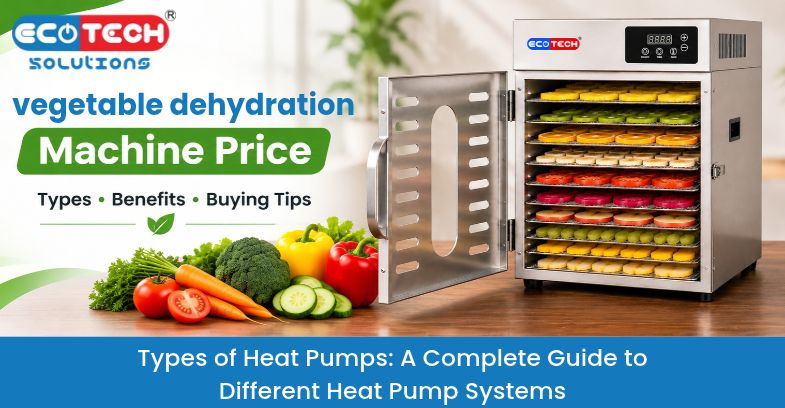
For example, EcoTech Solutions offers electric dehydrator models with different tray configurations to support small-batch and commercial food processing requirements.
Businesses researching the vegetable dryer machine price in India should compare machines according to their actual production requirements rather than selecting equipment based only on the initial investment.
You can explore our products to review available dehydration and heat pump solutions.
Different Types of Vegetable Dehydration Machines
Choosing the correct machine type is essential for achieving consistent drying results. Different technologies are designed for different production volumes and processing requirements.
1. Electrical Vegetable Dehydrator
An electrical dehydrator uses electric heating and hot-air circulation to remove moisture from vegetables. It is suitable for small businesses, food startups, restaurants, and commercial kitchens.
Its compact design makes it useful for businesses that need controlled batch processing without investing in a large industrial drying system.
Key features include:
- Electric heating technology
- Adjustable temperature settings
- Multiple drying trays
- Controlled hot-air circulation
- Compact equipment design
- Convenient operation
EcoTech Solutions provides Electrical Dehydrator models in 6, 12, and 16-tray configurations.
2. Industrial Food Dehydrator Machine
An industrial food dehydrator is designed for businesses processing larger quantities of vegetables and other food products.
These machines generally provide larger drying chambers, higher processing capacities, and configurations suitable for commercial production.
They can be used for:
- Onion and garlic processing
- Vegetable flakes and powders
- Dried vegetable ingredients
- Commercial food manufacturing
- Agricultural product processing
An Industrial Food Dehydrator Machine can help food processors establish more organized and repeatable production operations.
3. Heat Pump Vegetable Dehydrator
Heat pump dehydration technology uses a heat pump system to provide controlled drying conditions. Depending on the design, it can support efficient heating and moisture removal.
This technology can be worth considering for businesses that operate regularly and need to evaluate long-term energy consumption alongside production quality.
Important features may include:
- Controlled drying temperature
- Managed airflow
- Heat pump-based heating
- Suitable configurations for commercial applications
- Repeatable drying conditions
Businesses looking for advanced drying and heating solutions can also explore an experienced Heat Pump Manufacturer for suitable equipment options.
4. Tray-Type Vegetable Dryer
A tray-type dryer uses multiple trays to hold prepared vegetables inside a drying chamber. Heated air circulates around the products to remove moisture.
It is commonly considered for batch-based processing and can accommodate different vegetable varieties.
The number of trays, tray dimensions, airflow design, and drying chamber capacity influence its overall performance.
5. Continuous Vegetable Drying System
Continuous drying systems are designed for large-scale food processing operations that require a regular flow of raw materials.
Vegetables move through different drying sections using a conveyor or belt arrangement. These systems may be suitable for industrial facilities with high production requirements.
They generally involve a larger initial investment and require careful planning of the complete processing line.
Key Benefits of Using a Vegetable Dehydration Machine
Investing in suitable dehydration equipment can provide several advantages for food processing businesses.
1. Extended Storage Potential
Fresh vegetables contain significant moisture, which can contribute to spoilage. Controlled dehydration reduces moisture and helps improve the storage stability of processed vegetables.
Proper packaging and suitable storage conditions remain essential for maintaining product quality.
2. Reduced Dependence on Weather
Traditional sun drying depends heavily on environmental conditions. Rain, humidity, dust, and temperature fluctuations can affect the drying process.
A controlled dehydration machine allows businesses to process vegetables in a more consistent indoor environment.
3. Better Production Consistency
Modern drying equipment provides temperature and airflow controls that help achieve repeatable drying results.
This is especially important for manufacturers producing packaged vegetable ingredients and food products.
4. Multiple Product Applications
One suitable machine may be used for processing different vegetables, herbs, spices, and other food products, depending on its technical specifications.
This flexibility can help businesses expand their product range.
5. Improved Business Opportunities
Dehydrated vegetables can be used in:
- Instant soup mixes
- Ready-to-cook food products
- Vegetable powders
- Seasoning blends
- Packaged snacks
- Food manufacturing ingredients
These applications provide opportunities for food entrepreneurs and established manufacturers to develop value-added products.
Factors Affecting Vegetable Dryer Machine Price
Before purchasing equipment, it is important to understand why machine costs vary between manufacturers and models.
1. Production Capacity
Capacity is one of the biggest factors influencing the Vegetable dryer machine price.
Small machines are designed for limited batch production, while larger systems can handle higher quantities of raw vegetables.
Consider your daily processing requirements and expected future production before selecting a capacity.
2. Heating Technology
Electrical heating and heat pump technology have different equipment configurations and operating characteristics.
Compare their energy requirements, drying performance, and suitability for your products before making a decision.
3. Construction Material
Food processing equipment should be designed with hygiene and cleaning requirements in mind.
Stainless steel food-contact components, particularly SS 304 where specified, are commonly considered for food processing applications.
Material quality and fabrication standards can influence equipment cost.
4. Automation Level
Manual, semi-automatic, and automatic machines have different operational requirements.
Automatic controls may reduce the need for continuous manual adjustments, depending on the production setup.
5. Number of Trays and Drying Area
The number and size of trays determine how much product can be loaded into a batch.
However, tray count alone does not determine actual output. Vegetable type, loading thickness, moisture content, and drying time also matter.
6. Energy Consumption
Electricity consumption directly affects operating expenses.
Before finalizing the Vegetable dryer machine price, ask the manufacturer for connected load, expected energy consumption, and recommended operating conditions.
7. Customization and Installation
Customized drying chambers, special controls, higher production capacity, and installation requirements can increase the overall project cost.
Always request a detailed quotation that includes the equipment configuration and applicable additional charges.
How to Choose the Right Vegetable Dehydration Machine
Selecting equipment requires more than comparing product photographs and advertised prices.
Here are practical buying tips to help you make an informed decision.
- Identify Your Processing Requirements
Start by listing the vegetables you plan to process. Different vegetables have different moisture contents, textures, and drying requirements.
A machine suitable for leafy vegetables may require different operating conditions from one used for sliced onions or carrots.
- Calculate Your Required Capacity
Estimate how many kilograms of fresh vegetables you want to process per batch or per day.
Remember that fresh vegetable input weight and finished dehydrated product weight are different. Moisture removal causes a reduction in product weight.
- Check Temperature Control
Temperature control is important for achieving the desired drying quality.
Choose equipment that offers an appropriate temperature range for your products and allows suitable adjustments.
- Evaluate Airflow Distribution
Uneven airflow can lead to inconsistent drying between trays.
Ask about the airflow arrangement and whether the machine is designed to provide consistent drying throughout the chamber.
- Review Hygiene and Cleaning Requirements
Food processing equipment should be easy to clean and maintain.
Check tray construction, food-contact materials, chamber design, and accessibility for routine cleaning.
- Compare Manufacturers and Suppliers
When evaluating vegetable dryer machine manufacturers, consider their technical knowledge, equipment specifications, customization capabilities, and after-sales support.
Similarly, businesses comparing vegetable dryer machine suppliers in India should check product documentation, warranty terms, spare-parts availability, and installation assistance.
Do not choose a machine simply because its initial quotation is lower.
- Ask for a Product Trial
If possible, request a demonstration using the actual vegetable you intend to process.
A product trial can help you evaluate drying time, finished product quality, consistency, and machine suitability.
Why Choose EcoTech Solutions for Dehydration Equipment?
EcoTech Solutions provides food dehydration and heat pump technologies for different business and processing requirements.
Its product range includes electrical dehydrators and heat pump dehydration solutions designed for different production needs.
Businesses can explore the available options based on their processing capacity, vegetable varieties, operating conditions, and investment requirements.
When comparing vegetable dryer machine manufacturers, it is important to look beyond the purchase price and consider equipment design, technical specifications, operating requirements, and long-term support.
EcoTech Solutions encourages businesses to select dehydration equipment according to their actual application rather than choosing a model based only on advertised capacity.
Frequently Asked Questions (FAQs)
1. What is the vegetable dehydration machine price in India?
The price depends on the machine’s capacity, tray configuration, heating technology, construction material, and automation level. Small electric models and industrial systems have significantly different price ranges. Request a quotation based on your processing requirements.
2. Which type of vegetable dehydrator is suitable for small businesses?
An electrical tray dehydrator may be suitable for small food businesses, restaurants, and startups. The right model depends on batch size, product variety, and daily production requirements.
3. What vegetables can be processed in a dehydration machine?
Depending on the machine specifications, vegetables such as onions, garlic, carrots, tomatoes, potatoes, leafy vegetables, cabbage, and chillies can be processed.
4. How do I compare vegetable dryer machine manufacturers?
Compare their product specifications, manufacturing quality, capacity options, heating technology, warranty, installation assistance, and after-sales support. Request technical information before making a purchase.
5. Is a heat pump vegetable dryer energy efficient?
Heat pump dryers can offer energy-efficient drying performance depending on system design, operating conditions, and product requirements. Compare actual energy consumption and drying performance before selecting a model.
6. What capacity should I choose for my vegetable drying business?
Calculate your daily fresh vegetable input, desired production output, operating hours, and batch requirements. Select a machine that meets current demand while allowing reasonable room for future expansion.
7. What should I check before buying from vegetable dryer machine suppliers in India?
Check the supplier’s equipment specifications, food-contact materials, temperature control, airflow arrangement, power requirements, warranty, spare-parts availability, and service support.
8. Can one machine dry different types of vegetables?
Yes, many dehydrators can process multiple vegetable varieties. However, each product may require different preparation methods, loading arrangements, temperatures, and drying durations. Always follow the machine’s operating recommendations.
Final Thoughts
Choosing the right vegetable dehydration equipment is an important decision for food manufacturers, agricultural businesses, and entrepreneurs entering the food processing industry.
The Vegetable dryer machine price should be evaluated alongside capacity, heating technology, energy consumption, construction quality, and maintenance requirements.
Whether you need a compact electrical dehydrator for small-batch production or an industrial system for larger processing operations, selecting equipment according to your actual requirements can help improve productivity and maintain consistent product quality.
EcoTech Solutions offers dehydration and heat pump solutions for businesses exploring modern food processing technologies.
Contact Us: EcoTech Solutions