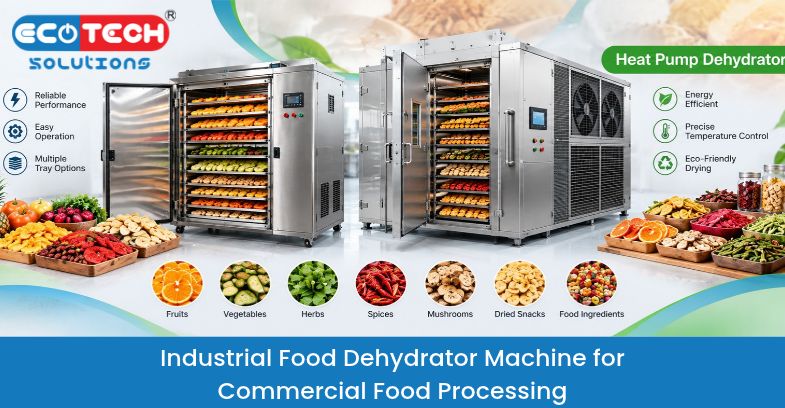
Food processing businesses need reliable drying equipment to preserve food quality, improve shelf life, and prepare products efficiently for storage and distribution. An industrial food dehydrator machine is designed for large-scale food processing applications where consistent temperature, controlled airflow, and efficient moisture removal are essential.
From fruits and vegetables to herbs, spices, and other food products, commercial dehydration can help reduce moisture while maintaining desirable product characteristics. Choosing the right drying technology is therefore an important decision for food manufacturers, processors, exporters, and commercial kitchens.
Modern dehydration systems are available in different configurations and capacities to suit various production requirements. Businesses can select equipment based on the type of food being processed, required output, available space, energy consumption, and desired drying conditions.
What Is an Industrial Food Dehydrator Machine?
An industrial food dehydrator machine is specialized food-processing equipment used to remove moisture from food products under controlled drying conditions. Unlike traditional open-air drying, industrial dehydration provides a controlled environment where temperature and airflow can be managed throughout the drying cycle.
The equipment generally uses heated air that circulates around food placed on trays or racks. As warm air passes through the product, moisture gradually evaporates. The process can be adjusted according to the characteristics of the food being dried.
Industrial dehydration is commonly used for:
- Fruits and vegetables
- Herbs and leafy vegetables
- Spices
- Mushrooms
- Food ingredients
- Agricultural products
- Processed food products
- Other moisture-sensitive products
The right industrial food dehydrator machine can help businesses establish a repeatable drying process and handle larger quantities than conventional household or small commercial dehydrators.
Why Use an Industrial Food Dehydrator Machine?
Moisture is one of the major factors that affects food stability and shelf life. Reducing moisture under controlled conditions can make products easier to store, transport, and package.
An industrial food dehydrator machine can provide several advantages for commercial food processing operations.
1. Controlled Drying Conditions
Industrial systems allow operators to control important drying parameters such as temperature and airflow. This can provide more consistent results from one production batch to another.
2. Improved Shelf Life
Removing excess moisture can help reduce conditions that support the growth of microorganisms. Proper dehydration, combined with appropriate packaging and storage, can contribute to longer product shelf life.
3. Large-Scale Processing
Commercial food businesses often need to process significant quantities of raw materials. Industrial drying equipment is designed to accommodate higher production volumes than small household machines.
4. Consistent Product Quality
Uniform airflow and controlled temperatures can help create more consistent drying results. Consistency is particularly important for businesses selling packaged food products.
5. Better Production Efficiency
Manual drying can require significant labor, space, and time. An automated or semi-automated drying system can make the overall production process more organized and repeatable.
How Does an Industrial Food Dehydrator Machine Work?
The basic principle behind an industrial food dehydrator machine is controlled moisture removal.
The food is first prepared according to the product requirements. Depending on the application, preparation may include washing, peeling, cutting, slicing, blanching, or other processing steps.
The prepared food is then placed on trays or racks inside the drying chamber. Heated air is circulated through the chamber. As the air comes into contact with the food, moisture moves from the product into the surrounding air.
The drying cycle continues until the desired moisture level is achieved.
A typical process may include:
- Food preparation – Products are cleaned and prepared for drying.
- Cutting or slicing – Products may be divided into appropriate sizes for uniform drying.
- Tray loading – Prepared food is distributed across drying trays.
- Temperature setting – The operator selects a suitable drying temperature.
- Air circulation – Heated air circulates through the drying chamber.
- Moisture removal – Moisture gradually leaves the food.
- Drying completion – The product is checked for the desired moisture level.
- Cooling and packaging – Dried products are cooled and packed under suitable conditions.
The exact drying time and temperature depend on the product, slice thickness, initial moisture content, desired final moisture level, and equipment configuration.
Applications of Industrial Food Dehydration
Commercial dehydration is used across a wide range of food-processing industries. Different products require different drying conditions, so selecting suitable equipment is important.
Common applications include:
Fruit Dehydration
Fruits such as apples, bananas, mangoes, pineapples, berries, and other produce can be processed into dried ingredients or snack products.
Vegetable Dehydration
Vegetables can be dried for use in packaged foods, soups, instant meals, seasoning mixes, and other food products.
Herb and Leafy Product Drying
Herbs and leafy vegetables often require careful temperature management because excessive heat can affect their appearance, aroma, and quality.
Spice Drying
Commercial processors may use controlled dehydration for various spices and agricultural ingredients.
Ingredient Processing
Dried food ingredients can be incorporated into ready-to-eat foods, bakery products, seasoning blends, snack foods, and other commercial products.
Heat Pump Food Dehydrator for Efficient Drying
Businesses looking for advanced drying technology can consider a HEAT PUMP FOOD DEHYDRATOR for suitable applications.
Heat pump dehydration uses heat pump technology to provide controlled drying conditions while circulating heated air through the drying chamber. Depending on the system design, this approach can support efficient moisture removal and controlled temperature management.
For commercial food processors, heat pump-based drying can be useful when the business needs repeatable drying conditions and efficient operation.
Companies involved in industrial heating and drying can also explore solutions from a specialized Heat Pump Manufacturer to understand available technologies for different applications.
Industrial Food Dehydrator Machine vs. Electrical Dehydrator
Businesses have different production requirements, so the choice between dehydration technologies should be based on capacity, application, operating conditions, and production goals.
An Electrical Dehydrator can be suitable for applications where electrical heating is preferred and the required production volume matches the equipment’s capacity.
An industrial system may be more appropriate when the business needs higher production capacity, controlled drying conditions, and continuous or batch processing.
When comparing options, consider:
- Required production capacity
- Type of food being dried
- Desired drying temperature
- Drying time
- Energy consumption
- Available installation space
- Automation requirements
- Maintenance requirements
- Initial investment
- Operating cost
Choosing an Industrial Food Dehydrator Supplier
Selecting the right industrial food dehydrator supplier is an important part of purchasing commercial drying equipment. The supplier should understand the customer’s application and help identify equipment suitable for the required production capacity and food product.
Before selecting an industrial food dehydrator supplier, businesses should evaluate:
- Equipment specifications
- Drying chamber capacity
- Number and size of trays
- Temperature control
- Air circulation system
- Energy requirements
- Construction materials
- Control system
- Safety features
- Maintenance requirements
- Technical support
- Installation assistance
- Warranty and after-sales service
A supplier that understands food-processing applications can also help businesses determine the appropriate equipment configuration.
Factors Affecting Industrial Food Dehydrator Price
The industrial food dehydrator price can vary significantly depending on the equipment design, capacity, technology, and specifications.
Businesses should avoid selecting equipment based only on the initial purchase price. The total cost of ownership should also be considered.
Factors that can influence industrial food dehydrator price include:
- Machine capacity
- Number of trays
- Drying chamber dimensions
- Heating technology
- Heat pump or electrical configuration
- Material and construction quality
- Automation level
- Temperature control system
- Air circulation technology
- Energy efficiency
- Customization requirements
- Installation requirements
For businesses comparing different models, reviewing the Food Dehydrator Machine Price in India can help provide a better understanding of available options and pricing considerations.
The lowest industrial food dehydrator price is not necessarily the most economical choice in the long term. A machine with better energy efficiency, appropriate capacity, durable construction, and reliable support may provide better overall value.
How to Select the Right Industrial Food Dehydrator Machine
Before purchasing an industrial food dehydrator machine, businesses should clearly define their production requirements.
Consider the following questions:
- What type of food will be dried?
- How much product needs to be processed per batch?
- What is the required final moisture level?
- How much floor space is available?
- What temperature range is required?
- How frequently will the machine operate?
- What type of heating system is preferred?
- Is automated temperature control required?
- What are the available power requirements?
- What level of technical support is needed?
Understanding these factors can help businesses choose a system that matches their actual production needs.
Benefits for Commercial Food Processing
A properly selected industrial food dehydrator machine can support commercial food-processing operations in several ways.
Key benefits include:
- Controlled drying conditions
- Consistent processing
- Higher production capacity
- Reduced dependence on weather conditions
- Better storage characteristics
- Efficient use of processing space
- Repeatable drying cycles
- Reduced manual drying requirements
- Flexible applications
- Improved production planning
Industrial dehydration can also help businesses turn fresh agricultural products into value-added dried products. This can create opportunities for packaged snacks, dried ingredients, seasoning products, and other commercial food categories.
Why Work With an Experienced Industrial Food Dehydrator Supplier?
Working with an experienced industrial food dehydrator supplier can make the equipment selection process easier. Different food products behave differently during drying, so equipment selection should be based on actual application requirements rather than machine capacity alone.
A knowledgeable supplier can help businesses understand equipment specifications, drying technology, capacity, installation requirements, and operating considerations.
Businesses should also consider long-term service availability. Technical support, spare parts, maintenance guidance, and troubleshooting assistance can be important throughout the equipment’s operating life.
Frequently Asked Questions
1. What is an industrial food dehydrator machine?
An industrial food dehydrator machine is commercial food-processing equipment designed to remove moisture from food products using controlled temperature and airflow. It can be used for fruits, vegetables, herbs, spices, and various other food products.
2. What foods can be processed using an industrial food dehydrator machine?
Depending on the equipment and drying conditions, industrial dehydrators can be used for fruits, vegetables, herbs, spices, mushrooms, and other suitable food products. Each product may require a different temperature, airflow, and drying duration.
3. How much does an industrial food dehydrator cost?
The industrial food dehydrator price depends on factors such as capacity, heating technology, number of trays, construction materials, automation, and customization. Businesses should compare equipment specifications and operating costs rather than considering purchase price alone.
4. How do I choose an industrial food dehydrator supplier?
When choosing an industrial food dehydrator supplier, consider equipment quality, technical specifications, production capacity, installation support, warranty, maintenance, spare-parts availability, and after-sales service.
5. Is a heat pump dehydrator suitable for commercial food processing?
A heat pump dehydrator can be suitable for commercial food-processing applications where controlled drying conditions and efficient operation are important. The appropriate system depends on the product, production volume, and required drying parameters.
6. What is the difference between a food dehydrator and a freeze dryer?
A food dehydrator removes moisture primarily through controlled heating and airflow, while freeze drying uses freezing followed by moisture removal under vacuum. The appropriate technology depends on the desired product characteristics and processing requirements.
7. Does the industrial food dehydrator machine require regular maintenance?
Yes. Regular inspection and maintenance can help maintain reliable operation. Cleaning the drying chamber, checking airflow components, inspecting electrical systems, and following the manufacturer’s maintenance recommendations are important.
8. Can industrial dehydrators be used for fruits and vegetables?
Yes. Industrial dehydrators are commonly used for processing fruits and vegetables. Drying conditions should be selected according to the characteristics of each product to achieve the desired moisture level and quality.
Conclusion
An industrial food dehydrator machine can be an important investment for businesses involved in commercial food processing. By providing controlled temperature, airflow, and moisture removal, industrial dehydration equipment can support consistent production and help transform fresh food products into shelf-stable, value-added products.
When choosing equipment, businesses should consider capacity, food type, drying requirements, energy consumption, construction, controls, maintenance, and technical support. Comparing different technologies and working with an experienced industrial food dehydrator supplier can help ensure the selected system matches the company’s production goals.
For businesses looking for reliable industrial heating and food-processing equipment, ET Solutions offers different dehydration and heat pump solutions designed for commercial and industrial applications. Selecting the right technology can help create a more controlled, efficient, and scalable food-processing operation.
Contact Us: EcoTech Solutions