
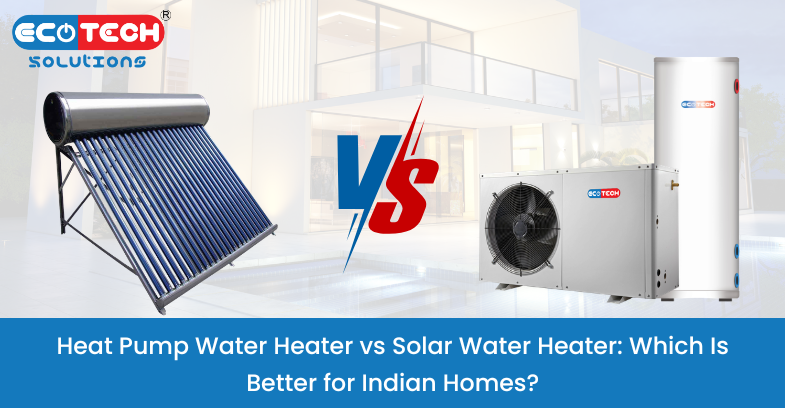
Hot water has become an essential requirement in modern Indian households. Whether it is for bathing, cleaning, hospitality operations, apartment complexes, healthcare facilities, educational institutions, or residential communities, the demand for reliable hot water continues to increase. However, rising electricity tariffs and growing environmental concerns have forced homeowners and facility managers to seek more energy-efficient alternatives to conventional electric geysers.
This is where the debate between heat pump water heater vs solar water heater becomes highly relevant.
Both technologies promise significant energy savings compared to traditional water heating systems. Both reduce dependence on expensive electrical heating elements. Both contribute to lower carbon emissions. Yet, they operate differently, involve different installation requirements, and deliver varying levels of performance depending on climate, usage patterns, and available infrastructure.
For homeowners, builders, architects, consultants, and procurement professionals, choosing the right water heating solution is not simply about the purchase price. It involves evaluating long-term operating costs, maintenance requirements, reliability, scalability, return on investment (ROI), and year-round performance.
In this comprehensive guide, we will compare heat pump water heaters and solar water heaters from technical, operational, and commercial perspectives to help you make an informed decision.
What Is a Heat Pump Water Heater?
Short Answer
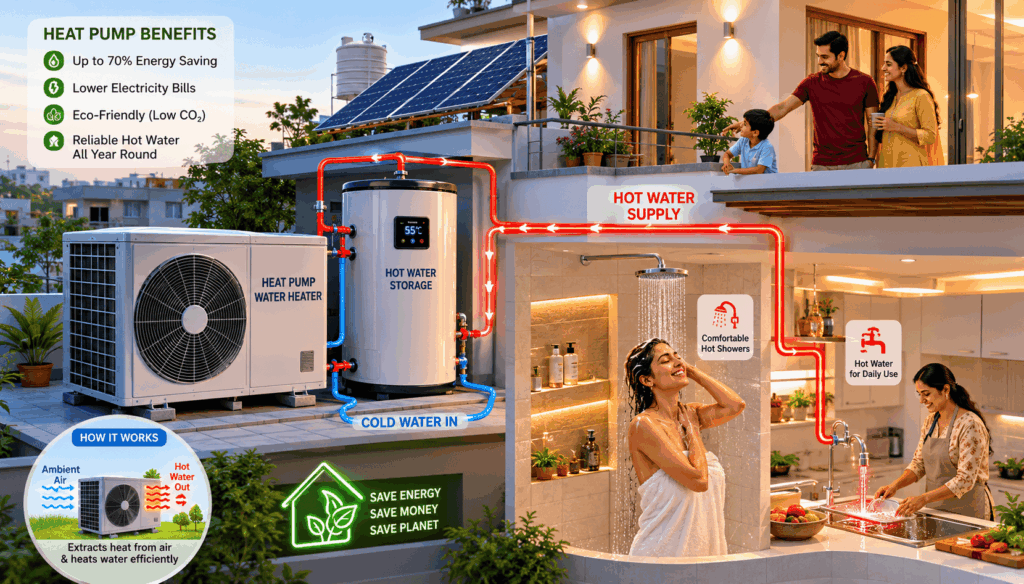
A heat pump water heater is an energy-efficient water heating system that extracts heat from ambient air and transfers it to water using refrigeration technology. Instead of generating heat directly like an electric geyser, it moves heat, making it significantly more efficient.
Heat pump technology operates on the same principle used in air conditioners and refrigerators but in reverse.
How It Works
A heat pump water heater consists of:
- Evaporator
- Compressor
- Condenser
- Expansion valve
- Water storage tank
- Smart control system
Step-by-Step Process
- Ambient air passes through the evaporator.
- Refrigerant absorbs heat from the air.
- The compressor increases refrigerant temperature.
- The condenser transfers heat to water.
- Hot water is stored for use.
- The cycle repeats continuously.
Because the system transfers heat instead of generating it through resistance heating, it can achieve a Coefficient of Performance (COP) ranging from 3 to 5.
This means:
- 1 kW electricity consumed
- 3–5 kW heat energy produced
What Is a Solar Water Heater?
Short Answer
A solar water heater uses solar energy collected through rooftop solar collectors to heat water. It is one of the most widely adopted renewable energy water heating systems in India.
Solar water heaters primarily consist of:
- Solar collectors
- Insulated storage tank
- Piping network
- Support structure
- Backup heating system
How It Works
- Solar radiation strikes collector panels.
- Heat transfers to water flowing through collectors.
- Heated water moves into storage tanks.
- Users access stored hot water when required.
The effectiveness of the system depends heavily on:
- Sunlight availability
- Weather conditions
- Roof orientation
- Seasonal variations
Heat Pump Water Heater vs Solar Water Heater: Quick Comparison
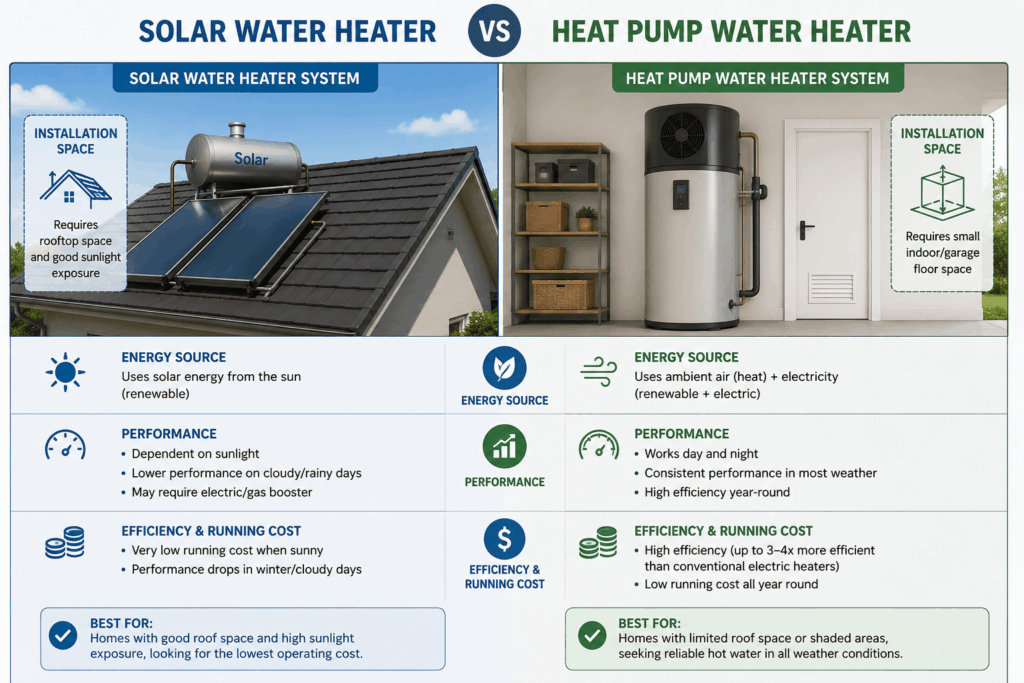
| Parameter | Heat Pump Water Heater | Solar Water Heater |
| Energy Source | Ambient Air | Sunlight |
| Performance at Night | Excellent | Requires stored water |
| Monsoon Performance | Consistent | Reduced efficiency |
| Installation Space | Compact | Large roof area |
| Initial Investment | Moderate | Moderate to High |
| Running Cost | Very Low | Near Zero |
| Automation | High | Limited |
| Scalability | Excellent | Moderate |
| Commercial Suitability | Excellent | Good |
| Weather Dependency | Low | High |
| Smart Controls | Available | Limited |
| Year-Round Reliability | High | Variable |
Heat Pump Water Heater vs Solar Water Heater: Which Is More Energy Efficient?
Heat Pump Efficiency
Heat pumps are among the most efficient water heating technologies available today.
Typical efficiency metrics:
| System | Efficiency |
| Electric Geyser | 95–100% |
| Solar Water Heater | Weather Dependent |
| Heat Pump Water Heater | 300–500% Equivalent |
Unlike electric geysers, heat pumps do not convert electricity directly into heat.
Instead, they move heat from surrounding air, resulting in significantly lower power consumption.
Real-World Example
A family consuming 300 liters of hot water daily may reduce electricity consumption by up to 70–80% compared to a conventional geyser.
Solar Water Heater Efficiency
Solar water heaters perform exceptionally well during:
- Summer
- Clear sunny days
- High solar irradiation regions
However, efficiency declines during:
- Monsoon season
- Cloudy weather
- Winter months
- Dust accumulation on collectors
In many Indian regions, backup heating systems become necessary for uninterrupted hot water supply.
Cost Comparison: Solar vs Heat Pump Cost
Initial Investment
| Capacity | Heat Pump | Solar Water Heater |
| 100 LPD | Moderate | Moderate |
| 200 LPD | Moderate | Moderate |
| 500 LPD | Higher | Higher |
| 1000+ LPD | Economical at Scale | Requires Large Roof Area |
Operating Cost
Heat pumps consume electricity but use it extremely efficiently.
Solar systems use free sunlight but often require:
- Backup electric heaters
- Additional maintenance
- Pump replacements
ROI Comparison
| Factor | Heat Pump | Solar |
| Typical ROI | 2–4 Years | 3–6 Years |
| Year-Round Savings | High | Variable |
| Predictability | High | Moderate |
Why Indian Homes Are Increasingly Choosing Heat Pumps
Several factors are driving demand for heat pump systems:
1. Reliable Hot Water Throughout the Year
Heat pumps continue operating during:
- Monsoon season
- Winter
- Cloudy weather
- Nighttime
2. Limited Rooftop Space
Urban homes increasingly face roof-space constraints.
Heat pumps require significantly less installation area than solar collectors.
3. Smart Automation
Modern systems offer:
- Temperature control
- Scheduling
- Remote monitoring
- Safety protection
- Automatic operation
4. Apartment and Villa Suitability
Heat pumps can easily support:
- Villas
- Apartments
- Residential societies
- Hotels
- Hospitals
without extensive rooftop infrastructure.
Advantages of Heat Pump Water Heaters
Key Benefits
✓ Up to 75% lower energy consumption
✓ Year-round operation
✓ Lower carbon footprint
✓ Compact installation
✓ Smart controls
✓ Longer equipment life
✓ Excellent scalability
✓ Consistent hot water supply
Industrial Insight
Many hotels, hospitals, hostels, and residential communities now prefer heat pumps because operational savings remain consistent regardless of weather fluctuations.
Advantages of Solar Water Heaters
Key Benefits
✓ Renewable energy source
✓ Low operating cost
✓ Environment-friendly
✓ Long service life
✓ Government incentive opportunities
Best Applications
Solar water heaters work best when:
- Roof area is abundant
- Sunlight is consistent
- Water demand is predictable
Disadvantages of Heat Pump Water Heaters
Considerations
- Higher initial investment than geysers
- Requires electrical power
- Professional installation recommended
- Performance influenced by ambient temperature
However, these limitations are generally offset by substantial long-term savings.
Disadvantages of Solar Water Heaters
Challenges
- Weather dependence
- Reduced monsoon performance
- Larger installation footprint
- Roof orientation requirements
- Backup heating often necessary
- Collector cleaning requirements
Buying Guide: Choosing the Best Water Heating System
When evaluating the best water heating system, consider:
Capacity Requirements
- 100–200 LPD: Small families
- 300–500 LPD: Large households
- 500+ LPD: Villas and commercial facilities
Material Quality
Prefer:
- SS304 tanks
- Corrosion-resistant components
- High-density insulation
Automation Features
Look for:
- Digital controllers
- Smart monitoring
- Auto scheduling
- Fault diagnostics
Power Consumption
Compare annual energy usage rather than only purchase price.
Maintenance Requirements
Evaluate:
- Spare part availability
- Service support
- Warranty coverage
Safety Features
Essential protections include:
- High-temperature cut-off
- Pressure relief valves
- Electrical protection systems
Common Mistakes to Avoid
- Selecting capacity based only on price.
- Ignoring roof space limitations.
- Overlooking maintenance costs.
- Focusing only on initial investment.
- Not evaluating year-round performance.
- Choosing unverified suppliers.
- Ignoring after-sales support.
Maintenance Tips
Heat Pump Systems
- Clean air filters regularly.
- Inspect refrigerant circuits.
- Check electrical connections.
- Schedule annual servicing.
Solar Systems
- Clean collector surfaces frequently.
- Inspect piping.
- Check insulation integrity.
- Verify backup heater operation.
Future Trends in Water Heating Technology
Emerging innovations include:
- IoT-enabled heat pumps
- AI-based energy optimization
- Hybrid solar-heat pump systems
- Smart building integration
- High-COP inverter compressors
- Sustainable refrigerants
These technologies will further improve energy efficiency and operational savings.
Why Choose ET Solutions?
ET Solutions has established itself as a trusted provider of advanced heat pump technology designed for Indian operating conditions.
What Sets ET Solutions Apart?
- Energy-efficient heat pump systems
- High-performance engineering
- Reliable technical support
- Customized sizing solutions
- Installation guidance
- Long-term service support
- Residential and commercial expertise
Whether you require a system for a home, apartment complex, hotel, hospital, educational institution, or industrial facility, ET Solutions delivers solutions focused on efficiency, reliability, and long-term savings.
FAQs
Heat pumps generally provide more consistent year-round performance, while solar water heaters depend heavily on sunlight availability.
Yes. Modern heat pumps are designed to operate efficiently across most Indian climatic conditions.
A heat pump can reduce water heating energy consumption by up to 70–80% compared to conventional electric geysers.
Performance may decline significantly during prolonged cloudy weather, often requiring backup heating.
Typical payback periods range from 2 to 4 years depending on usage and electricity tariffs.
Heat pumps generally require less routine maintenance than solar systems with exposed rooftop collectors.
Yes. They are ideal for apartments, villas, residential societies, hotels, and hospitals.
Initial costs can vary, but heat pumps often deliver faster and more predictable long-term savings.
Conclusion
When comparing heat pump water heater vs solar water heater, there is no universal answer for every application. Solar water heaters remain a good choice where rooftop space is abundant and sunlight is consistently available.
However, for most modern Indian homes seeking year-round reliability, superior energy efficiency, smart automation, lower maintenance challenges, and predictable ROI, heat pump water heaters offer a compelling advantage.
As electricity costs continue to rise and energy efficiency becomes a priority, heat pump technology is increasingly emerging as the preferred long-term water heating solution. If you are evaluating the best water heating system for your property, contact ET Solutions for expert guidance, customized recommendations, installation support, technical consultation, pricing quotations, and export inquiries.
Contact Us: EcoTech Solutions