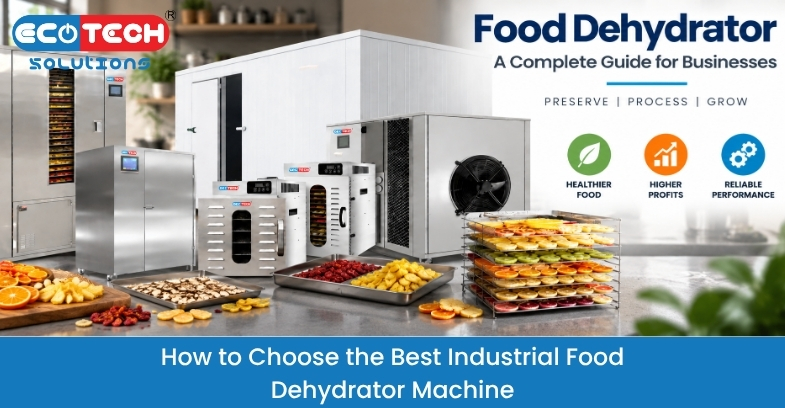
Choosing the right industrial food dehydrator machine is an important decision for food processing businesses that want consistent drying quality, efficient production, and better product shelf life. From fruits and vegetables to herbs, spices, and other food products, the right dehydration equipment can make a significant difference in production efficiency.
With many types, capacities, and technologies available, selecting a machine based only on price can lead to higher operating costs or inconsistent results. Businesses should consider capacity, temperature control, airflow, construction materials, energy consumption, automation, maintenance, and after-sales support before making a purchase.
This guide explains the key factors to consider when choosing an industrial food dehydrator machine for your food processing requirements.
What Is a Food Dehydrator?
Understanding what is a food dehydrator is the first step before selecting a machine. A food dehydrator is equipment designed to remove moisture from food through controlled heat and airflow.
Removing moisture can help reduce the conditions that support microbial growth and can improve the storage stability of properly processed and packaged food. Dehydration is commonly used for fruits, vegetables, herbs, spices, and various other food products.
How Does a Food Dehydrator Work?
A food dehydrator generally works by circulating warm air around food placed on trays or racks. As warm air moves across the food, moisture evaporates from the product and is carried away through the airflow system.
The basic process includes:
- Preparing and cutting the food.
- Arranging food evenly on trays.
- Setting the appropriate temperature.
- Circulating warm air through the chamber.
- Removing moisture from the product.
- Cooling the dried food.
- Packaging and storing the finished product.
Why Is Dehydration Important for Food Businesses?
Commercial dehydration can help businesses process seasonal produce and create products that are easier to store, transport, and package.
Some common applications include:
- Dried fruits.
- Dried vegetables.
- Herbs and spices.
- Mushrooms.
- Fruit snacks.
- Vegetable chips.
- Ingredients for food manufacturers.
- Specialty dried food products.
Determine Your Food Dehydration Requirements
Before purchasing an industrial food dehydrator machine, identify exactly what you plan to process. Different foods have different moisture levels, textures, thicknesses, and drying requirements.
A machine suitable for sliced fruits may not necessarily be ideal for herbs or thicker vegetables. Understanding your products helps you select appropriate capacity, temperature control, airflow, and drying technology.
Identify the Products You Will Dry
Make a list of all products you expect to process.
Consider:
- Fruits.
- Vegetables.
- Herbs.
- Spices.
- Mushrooms.
- Meat or other specialized products, where the equipment and validated food-safety process are appropriate.
Calculate Your Production Capacity
Estimate how much fresh food you need to process per batch and per day.
Ask yourself:
- How many kilograms need to be dried per batch?
- How many batches will you run each day?
- How much production do you expect in the future?
- How much floor space is available?
- How much labor is available for loading and unloading?
Choosing a machine that is too small can increase production time, while buying an unnecessarily large machine can increase the initial investment.
Choose the Right Dehydrator Capacity
Capacity is one of the most important factors when selecting an industrial food dehydrator. Do not evaluate capacity only by the number of trays. Consider the actual usable drying area and recommended product loading weight.
Factors That Determine Capacity
The effective capacity depends on:
- Number of trays.
- Tray dimensions.
- Tray spacing.
- Drying chamber size.
- Product thickness.
- Product loading density.
- Fresh food weight per batch.
- Required drying time.
Why Tray Size Matters
Two dehydrators may have the same number of trays but provide different usable drying areas. A larger tray can accommodate more product, while sufficient spacing can help maintain proper airflow.
Before purchasing, ask the supplier for the actual tray dimensions and recommended loading weight.
Plan for Future Growth
If your food processing business is growing, consider your expected production requirements over the next few years.
A slightly larger machine may be more practical if it prevents you from needing another machine shortly after your initial purchase.
Evaluate Temperature Control
Temperature control is another critical consideration when selecting a food dehydrator. Different food products require different drying conditions.
Excessive temperatures may negatively affect certain products, while insufficient heat may extend drying times.
Important Temperature Control Features
Look for:
- Adjustable temperature settings.
- Digital temperature display.
- Reliable temperature controller.
- Consistent heat distribution.
- Timer functionality.
- Overheating protection.
Why Temperature Accuracy Matters
Consistent temperature helps create repeatable drying conditions from batch to batch.
For example, if you are processing fruits and require a controlled drying temperature, significant temperature fluctuations may produce differences in color, texture, or final moisture content.
Always ask the manufacturer about the machine’s temperature range and temperature uniformity before purchasing.
Check the Airflow and Drying System
Airflow is essential because heat alone does not remove moisture efficiently. Warm air needs to move across the food and carry moisture away from the drying chamber.
A well-designed industrial food dehydrator should provide consistent airflow throughout the drying area.
What to Check About Airflow
Ask the manufacturer:
- How is air distributed through the chamber?
- Is the airflow adjustable?
- Does every tray receive sufficient airflow?
- Is the drying process uniform?
- Do trays need to be rotated?
- How is moist air removed from the chamber?
Why Uniform Airflow Matters
Poor airflow can cause uneven drying. Some trays may become dry while other products remain moist.
Uniform airflow can help improve:
- Batch consistency.
- Drying efficiency.
- Product quality.
- Production predictability.
- Operator convenience.
Consider the Construction Material
The construction material should be carefully evaluated when buying food processing equipment. Stainless steel is commonly used in food equipment because of its durability, cleanability, and corrosion resistance under appropriate conditions.
Benefits of Stainless Steel Construction
A stainless steel dehydrator can provide several practical advantages:
- Easy cleaning.
- Durable construction.
- Professional appearance.
- Resistance to corrosion in suitable environments.
- Suitable surfaces for food-processing applications.
- Long-term usability.
Check Food-Contact Components
Do not look only at the outside of the machine. Ask about the materials used for:
- Trays.
- Racks.
- Drying chamber.
- Internal surfaces.
- Fasteners and other food-contact components.
You can explore ET Solutions’ Stainless Steel Food Dehydrator as an example of stainless steel dehydration equipment.
Compare Energy Efficiency
Energy consumption can have a major effect on the long-term cost of operating a dehydrator. Therefore, businesses should consider operating costs in addition to the initial purchase price.
Factors That Affect Energy Consumption
Energy use can depend on:
- Heating technology.
- Machine capacity.
- Insulation.
- Drying temperature.
- Drying duration.
- Food moisture content.
- Loading quantity.
- Airflow.
- Number of daily batches.
Look Beyond Wattage
A machine with a lower rated power does not automatically mean lower overall operating costs. If it takes significantly longer to complete each batch, total energy consumption may still be substantial.
Ask the manufacturer for practical information such as:
- Rated electrical power.
- Expected drying time.
- Estimated energy consumption.
- Recommended loading.
- Operating temperature.
- Required electrical supply.
Understand Different Types of Food Dehydrators
Different dehydration technologies are available for different production requirements. Understanding these options can help you select the appropriate system.
Tray Food Dehydrator
Tray dehydrators use multiple trays inside an enclosed drying chamber.
Advantages
- Suitable for batch production.
- Easy to load and unload.
- Flexible for different products.
- Available in different sizes.
- Suitable for small and medium-scale operations.
Cabinet Food Dehydrator
Cabinet-style dehydrators provide an enclosed drying area and can accommodate larger quantities than many small countertop or basic commercial units.
Advantages
- Larger batch capacity.
- Controlled drying environment.
- Suitable for commercial processing.
- Can be configured for specific production requirements.
Heat Pump Dehydrator
Heat pump dehydration systems use heat pump technology for controlled drying and can be considered where energy efficiency and lower-temperature drying are important.
Potential Benefits
- Controlled drying conditions.
- Potentially improved energy efficiency.
- Suitable for selected food products.
- Can support commercial and industrial applications.
For businesses interested in combined heat pump and dehydration technology, explore the All in One Heat Pump Dehydrator.
Compare the Industrial Dehydrator Machine Price
The industrial dehydrator machine price varies according to capacity, technology, materials, automation, and customization.
A small tray-based machine will naturally have different pricing from a large industrial drying system.
What Affects Industrial Dehydrator Machine Price?
The main factors include:
- Machine capacity.
- Number of trays.
- Tray dimensions.
- Stainless steel construction.
- Heating technology.
- Airflow system.
- Temperature controls.
- Automation.
- Energy efficiency.
- Customization.
- Installation.
- Warranty.
- Technical support.
Do Not Choose Only the Lowest Price
The cheapest machine may not always provide the best long-term value.
Instead, compare:
- Initial purchase cost.
- Energy consumption.
- Production capacity.
- Drying consistency.
- Maintenance requirements.
- Spare-part availability.
- Warranty.
- After-sales service.
A slightly higher initial investment may be worthwhile if the equipment provides better reliability, efficiency, and production consistency.
Evaluate Automation and Controls
Automation can make the drying process easier to manage, particularly for businesses running multiple batches every day.
Useful Features to Consider
Look for:
- Digital temperature control.
- Digital timer.
- Programmable drying settings.
- Automatic shutdown.
- Temperature alarms.
- Adjustable airflow.
- Easy-to-read display.
However, advanced automation should match your actual requirements. There is no need to pay for features that will not improve your production process.
Understand the Food Dehydration Process
Before buying a machine, understand the Food Dehydration Process. This allows you to determine which equipment features are most important for your products.
Step 1: Prepare the Food
Food may need to be washed, sorted, peeled, sliced, or otherwise prepared before drying.
Step 2: Load the Trays
Arrange food evenly across the trays. Avoid excessive overlapping because it can interfere with airflow and slow the drying process.
Step 3: Set the Drying Conditions
Choose an appropriate temperature and drying duration based on the product and validated process requirements.
Step 4: Monitor the Drying Process
Monitor the product during processing to determine whether it is reaching the desired final characteristics.
Step 5: Cool the Product
After drying, allow the product to cool under appropriate hygienic conditions before packaging.
Step 6: Package and Store
Proper packaging and storage are essential for maintaining the quality of dehydrated food.
Consider Cleaning and Maintenance
A dehydrator used regularly in food processing should be easy to clean and maintain.
Cleaning Features to Look For
- Removable trays.
- Accessible internal surfaces.
- Smooth construction.
- Easy-to-clean food-contact surfaces.
- Simple chamber access.
- Serviceable components.
Regular cleaning helps maintain hygienic operating conditions and can also help prevent accumulated food particles from affecting machine performance.
Check Warranty and After-Sales Support
A dehydrator is a long-term business investment. Supplier support can therefore be just as important as the machine itself.
Questions to Ask the Manufacturer
Before purchasing, ask:
- What is the warranty period?
- Is installation included?
- Is operator training available?
- Are spare parts readily available?
- What maintenance is required?
- Is technical support available?
- How quickly can service issues be addressed?
- Can the machine be customized?
Choosing an experienced supplier can make equipment ownership easier over the long term.
Common Mistakes to Avoid
Businesses can make costly mistakes when purchasing food drying equipment.
Mistake 1: Choosing Only by Price
The lowest price may not provide the best value if capacity, efficiency, or reliability is poor.
Mistake 2: Ignoring Production Capacity
An undersized machine can increase labor and processing time.
Mistake 3: Looking Only at Tray Count
Tray dimensions and usable drying area are equally important.
Mistake 4: Ignoring Energy Consumption
Electricity can become a significant operating expense for businesses running multiple batches.
Mistake 5: Not Testing the Product
Whenever possible, conduct a sample drying test before making a major equipment investment.
Mistake 6: Ignoring After-Sales Support
A machine is a long-term investment, so service and spare-parts availability should be considered.
Create a Checklist Before Buying
Before selecting an industrial food dehydrator machine, use this checklist:
- Product types identified.
- Required daily capacity calculated.
- Fresh product loading weight confirmed.
- Tray dimensions checked.
- Temperature range verified.
- Airflow system evaluated.
- Construction material confirmed.
- Energy requirements reviewed.
- Automation requirements identified.
- Cleaning requirements understood.
- Warranty checked.
- After-sales support confirmed.
- Spare-parts availability confirmed.
- Product testing considered.
- Total ownership cost compared.
Frequently Asked Questions
- What is a food dehydrator used for?
A food dehydrator is used to remove moisture from food through controlled heat and airflow. It can be used for products such as fruits, vegetables, herbs, spices, and other suitable foods.
- How do I choose the best industrial food dehydrator machine?
Consider your product type, batch capacity, temperature requirements, airflow, construction, energy consumption, automation, maintenance, and supplier support before making a purchase.
- What factors affect industrial dehydrator machine price?
The industrial dehydrator machine price depends on capacity, materials, heating technology, airflow design, automation, customization, installation, and after-sales support.
- Is stainless steel good for a food dehydrator?
Stainless steel is commonly used in food processing equipment because it is durable, easy to clean, and resistant to corrosion when properly maintained.
- Is a heat pump dehydrator suitable for commercial use?
A heat pump dehydrator can be considered for commercial applications where controlled drying and energy efficiency are important. The appropriate system depends on the product, capacity, and required drying conditions.
Why Choose the Right Dehydrator Manufacturer?
Selecting the right manufacturer is an important part of purchasing dehydration equipment. A reliable supplier should be able to provide detailed specifications, explain machine capabilities, offer appropriate technical support, and help you select equipment according to your production requirements.
ET Solutions provides heat pump and dehydration solutions for different applications. Businesses can explore the Heat Pump Manufacturer website to learn more about available technologies and products.
When comparing manufacturers, consider:
- Product quality.
- Technical expertise.
- Machine customization.
- Product range.
- Warranty.
- Installation support.
- Spare parts.
- Technical service.
- Long-term customer support.
Conclusion
Choosing the best industrial food dehydrator machine requires careful consideration of more than the purchase price. Your decision should be based on your food products, production capacity, temperature requirements, airflow, construction, energy efficiency, automation, hygiene, maintenance, and long-term support.
A suitable dehydrator can help create a more consistent and efficient food drying operation. Before purchasing, compare specifications from different suppliers, calculate your actual production requirements, and consider conducting a product test.
Most importantly, select equipment that can meet your current requirements while providing enough flexibility for future business growth. With the right machine and a properly controlled food dehydration process, businesses can develop an efficient approach to producing high-quality dried food products.
Contact Us: EcoTech Solutions