
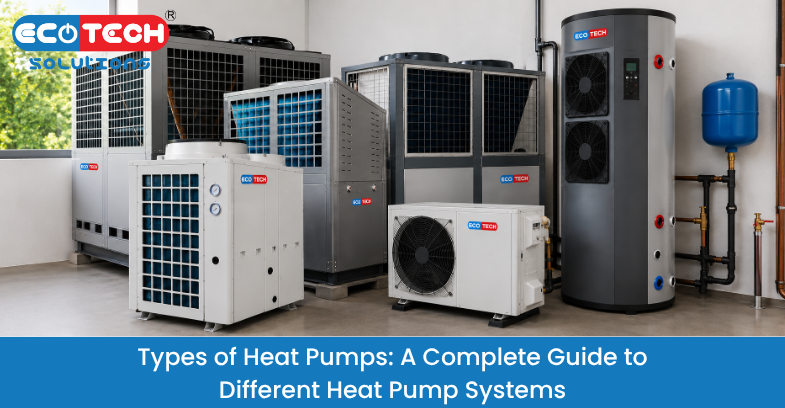
Heat pumps are becoming an increasingly important technology for efficient heating, cooling, and hot water production. Unlike conventional heating equipment that generates heat by burning fuel or using electrical resistance, a heat pump transfers available heat from one location to another. This process can help reduce energy consumption while providing reliable temperature control.
Understanding the types of heat pumps available is important when choosing a system for a home, commercial property, industrial facility, swimming pool, or hot water application. Different systems are designed for different heat sources, operating conditions, temperature requirements, and installation environments.
This guide explains the major different types of heat pumps, how they work, their applications, advantages, and factors to consider before selecting a system.
What Is a Heat Pump?
A heat pump is a mechanical system that transfers thermal energy from one source to another. Depending on the system, it can extract heat from the air, ground, water, or another available heat source.
During heating operation, the system absorbs heat from a relatively low-temperature source and transfers it to a higher-temperature area. In reversible systems, the process can also be changed to provide cooling.
A typical heat pump includes several important components:
- Compressor
- Evaporator
- Condenser
- Expansion valve
- Refrigerant
- Fans or pumps, depending on the system
The basic refrigeration cycle allows the heat pump to move thermal energy efficiently. Because the system transfers heat instead of directly generating it, it can achieve high energy efficiency under suitable operating conditions.
Why Are There Different Types of Heat Pumps?
There is no single heat pump design suitable for every application. Buildings, industries, and hot water systems have different requirements.
For example, one property may have easy access to outdoor air but limited space for ground loops. Another facility may have access to a large water source or require high-temperature hot water for industrial processes.
The main differences between types of heat pumps are based on:
- The heat source
- The heat delivery method
- Operating temperature
- Required heating capacity
- Installation environment
- Available space
- Energy efficiency requirements
- Application type
Understanding these differences makes it easier to select an appropriate system.
Main Types of Heat Pumps
The most common heat pump types can be classified according to their heat source and how heat is delivered. The major categories include air source, ground source, water source, air-to-water, air-to-air, and specialized systems.
1. Air Source Heat Pumps
Air source heat pumps extract thermal energy from outdoor air and transfer it into a building or water heating system. They are among the most widely used systems because air is readily available and installation can be comparatively straightforward.
An air source system generally consists of an outdoor unit and indoor equipment or a water heating connection.
There are two common configurations:
- Air-to-air heat pumps
- Air-to-water heat pumps
Air-to-Air Heat Pumps
Air-to-air heat pumps transfer heat between outdoor air and indoor air. During heating mode, the outdoor unit extracts heat from the surrounding air and transfers it indoors.
These systems are commonly used for:
- Residential heating and cooling
- Offices
- Shops
- Small commercial buildings
- Individual rooms and zones
Many air-to-air systems are reversible, allowing the same equipment to provide cooling during warmer weather.
Air-to-Water Heat Pumps
Air-to-water heat pumps extract heat from outdoor air and transfer it to water. The heated water can then be used for space heating or hot water applications, depending on the system design.
These systems can be useful where water-based heating or hot water distribution is preferred.
2. Ground Source Heat Pumps
Ground source heat pumps, also called geothermal heat pumps, use the ground as their heat source or heat sink.
The temperature below the ground can remain more stable than outdoor air throughout the year. A ground loop circulates a fluid through underground pipes, allowing thermal energy to be exchanged between the ground and the heat pump.
Ground source systems can offer efficient performance, but installation typically requires appropriate land, drilling, or underground loop infrastructure.
Common applications include:
- Residential buildings
- Commercial properties
- Large facilities
- Institutional buildings
- Projects designed for long-term energy efficiency
Because installation can be more complex than some air-source systems, site conditions should be evaluated before choosing this option.
3. Water Source Heat Pumps
Water source heat pumps use water as the primary heat exchange source. Depending on the design, the water may come from a pond, lake, well, groundwater system, or another suitable source.
Water can provide a relatively stable thermal environment, which may help the system operate efficiently.
Water source systems may be considered for:
- Commercial buildings
- Large facilities
- Industrial applications
- Properties with suitable water resources
However, the availability, quality, temperature, and regulatory requirements of the water source must be assessed before installation.
For more information about specifications, applications, and available configurations, see the Water to Water Heat Pump from ET Solutions.
4. Air-to-Water Heat Pumps
Air-to-water systems deserve special attention because they are increasingly used for efficient water heating.
These systems absorb heat from ambient air and transfer it to water through a heat exchanger. The heated water can then be stored or distributed for the required application.
Air-to-water heat pumps can be used for:
- Domestic hot water
- Commercial hot water
- Space heating
- Hospitality facilities
- Healthcare facilities
- Institutional buildings
For residential applications, a properly selected system can provide hot water while reducing reliance on conventional electric heating.
If you are evaluating a residential system, you can learn more about Domestic Heat Pump solutions and their potential applications.
5. Air-to-Air Heat Pumps
Air-to-air systems move heat between outdoor and indoor air. They are commonly used for both heating and cooling.
One important advantage is their ability to provide two functions through a reversible refrigeration cycle. In winter, heat is transferred indoors, while during cooling operation, heat is moved from the indoor environment to the outside.
Air-to-air systems are particularly suitable for buildings where air conditioning and space heating are both required.
6. Geothermal Heat Pumps
Geothermal heat pumps use the relatively stable temperature of the earth to exchange thermal energy. They are generally categorized under ground source heat pump systems.
The underground loop can be installed horizontally or vertically, depending on available land and site conditions.
Geothermal systems can be attractive for projects where long-term efficiency is a priority. However, the initial installation may require more planning and investment than certain air-source alternatives.
7. Hybrid Heat Pump Systems
Hybrid heat pump systems combine a heat pump with another heating technology, such as a conventional boiler.
The system can select the most appropriate heat source depending on outdoor temperature, energy costs, heating demand, or operating conditions.
Hybrid systems can be useful when:
- Existing heating equipment needs to be retained
- Heating demand varies throughout the year
- Extremely low temperatures may affect heat pump performance
- A backup heating source is desirable
This approach allows the heat pump and secondary heating equipment to work together rather than relying entirely on one technology.
8. High-Temperature Heat Pumps
High-temperature heat pumps are designed to produce water or process heat at higher temperatures than many standard heat pump systems.
They can be particularly relevant to commercial and industrial applications where hot water or process heating is required.
Potential applications include:
- Manufacturing facilities
- Hotels
- Hospitals
- Food processing
- Commercial laundries
- Industrial processes
The appropriate system depends on the required water temperature, heat load, source temperature, and operating conditions.
9. Absorption Heat Pumps
Absorption heat pumps operate differently from conventional electrically driven compression heat pumps. Instead of relying primarily on a mechanical compressor, they use a heat-driven absorption cycle.
These systems can use sources such as natural gas, waste heat, or other thermal energy inputs, depending on the configuration.
They may be considered for specialized commercial and industrial applications where a suitable heat source is available.
Comparing Different Heat Pump Systems
The types of heat pump systems differ considerably in terms of installation, performance, application, and cost.
| Heat Pump Type | Main Heat Source | Common Applications |
| Air Source | Outdoor air | Homes, offices, commercial buildings |
| Ground Source | Ground | Residential and commercial buildings |
| Water Source | Water | Commercial and large facilities |
| Air-to-Water | Outdoor air | Hot water and heating |
| Air-to-Air | Outdoor air | Heating and cooling |
| Geothermal | Ground | Long-term heating and cooling |
| Hybrid | Multiple sources | Residential and commercial applications |
| High-Temperature | Air, water, or other sources | Industrial and commercial processes |
| Absorption | Thermal energy source | Specialized commercial and industrial uses |
How to Choose the Right Heat Pump
Choosing between different heat pump types requires more than comparing the purchase price. The system should be selected according to the application’s actual heating or hot water requirements.
1. Determine the Required Capacity
Start by calculating the amount of heating or hot water required. An undersized system may struggle to meet demand, while an oversized system may increase unnecessary costs.
2. Consider the Available Heat Source
Air-source systems require access to suitable ambient air. Ground-source systems require underground loop installation, while water-source systems require an appropriate water resource.
3. Check the Required Temperature
Residential hot water, commercial hot water, space heating, and industrial process heating may require different temperature levels.
4. Evaluate Installation Space
Available indoor and outdoor space can influence which system is practical.
5. Consider Operating Costs
Look beyond the initial equipment cost. Energy consumption, maintenance, expected lifespan, and operating conditions can significantly affect the total cost over time.
6. Select a Suitable Manufacturer
The manufacturer and system quality can have an important impact on reliability, efficiency, technical support, and long-term performance.
Businesses looking for reliable solutions can explore ET Solutions, a Heat Pump Manufacturer for different heating and hot water applications.
Heat Pumps for Domestic Applications
Domestic heat pump systems are designed for residential requirements such as hot water and space heating.
Compared with conventional electric resistance heating, heat pumps can transfer available thermal energy rather than generating all the required heat directly.
When selecting a domestic system, homeowners should consider:
- Household size
- Daily hot water demand
- Available installation space
- Climate
- Required water temperature
- Energy efficiency
- Maintenance requirements
A correctly sized system can provide consistent hot water while supporting more efficient energy use.
Heat Pumps for Commercial Applications
Commercial buildings often have substantially higher and more consistent hot water requirements than individual homes.
Hotels, hospitals, restaurants, educational institutions, gyms, and other facilities may need hot water throughout the day.
Commercial heat pump systems can be designed according to factors such as:
- Peak hot water demand
- Storage requirements
- Operating temperature
- Number of users
- Available heat sources
- Daily operating hours
For businesses exploring larger systems, Commercial Heat Pumps can be evaluated according to specific application requirements.
Benefits of Heat Pump Technology
The advantages of heat pump technology depend on the system type, application, climate, and operating conditions. However, common benefits can include improved energy efficiency, reduced dependence on conventional heating methods, and flexible applications.
Heat pumps can also be used across residential, commercial, and industrial environments.
For a deeper overview, read about the Benefits of Heat Pump technology, including its potential energy and operational advantages.
Maintenance Requirements
Regular maintenance helps keep heat pump systems operating efficiently.
Maintenance may include:
- Cleaning filters
- Inspecting heat exchangers
- Checking refrigerant-related components
- Inspecting electrical connections
- Cleaning outdoor coils
- Checking water connections
- Monitoring system performance
Commercial and industrial systems may require more comprehensive maintenance programs because of their larger capacity and longer operating hours.
Conclusion
Understanding the types of heat pumps is the first step toward selecting an efficient heating or hot water solution. Air source, ground source, water source, air-to-water, air-to-air, geothermal, hybrid, high-temperature, and absorption systems each have different operating characteristics and applications.
The best choice depends on factors such as heat demand, available heat source, required temperature, installation conditions, energy goals, and budget. Residential users may have different requirements from hotels, hospitals, factories, and other commercial facilities.
By comparing the available heat pump types and evaluating the requirements of the specific application, users can make a more informed decision and select a system designed for reliable and efficient performance.
Contact Us: EcoTech Solutions