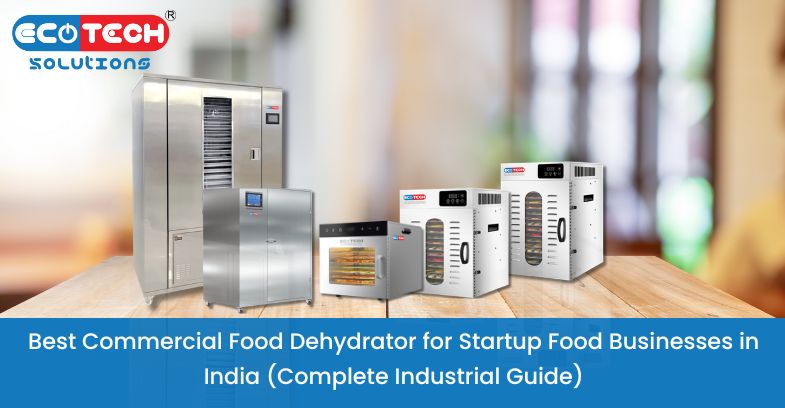
Starting a food processing business in India is one of the fastest-growing opportunities in the manufacturing sector. From dehydrated fruits and vegetable snacks to herbal powders and export-grade ingredients, demand is increasing rapidly.
However, most new entrepreneurs struggle with one critical decision—choosing the right commercial food dehydrator for startup operations.
Many startups fail at this stage because they either:
- Buy underpowered household machines that cannot scale
- Or invest in oversized industrial systems that increase costs unnecessarily
This guide is designed to help you make the correct industrial decision based on engineering logic, ROI, and real production requirements.
What is a Commercial Food Dehydrator for Startup?
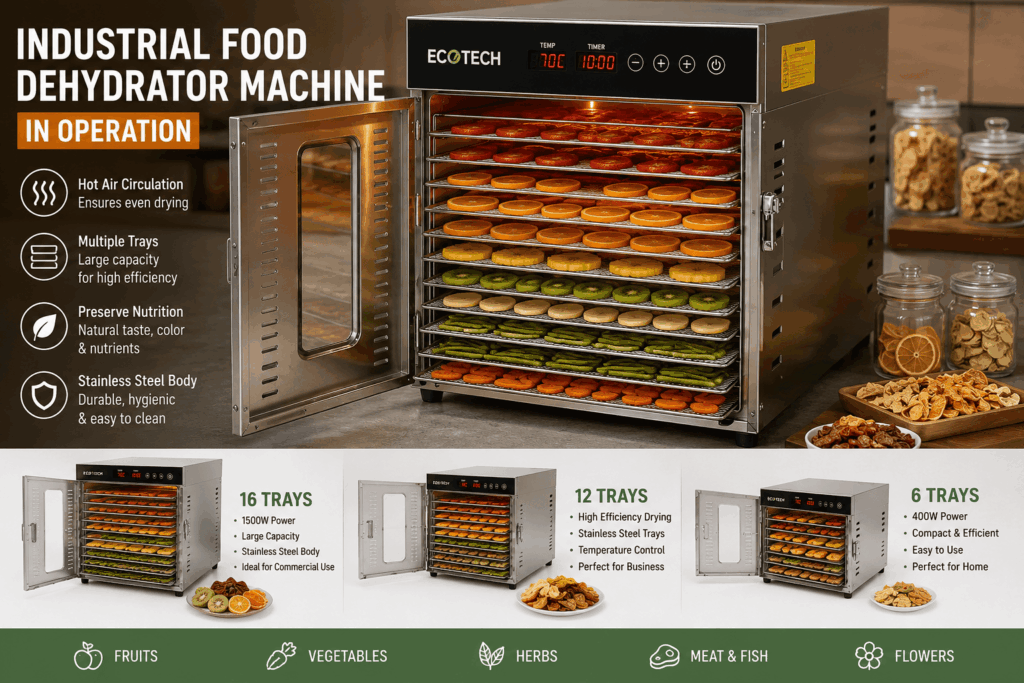
A commercial food dehydrator for startup is an industrial machine designed to remove moisture from food products under controlled temperature, airflow, and humidity conditions.
Unlike domestic dryers, startup-grade systems are built for:
- Continuous batch production
- Industrial hygiene standards
- Uniform drying results
- Energy-efficient operation
- Scalable output capacity
These machines are widely used in small food factories, agro-processing units, and export-oriented businesses.
How Commercial Food Dehydrator Works
The working principle is based on controlled thermal dehydration.
Step-by-step process:
- Raw materials are loaded onto stainless steel trays
- Controlled hot air is circulated inside the chamber
- Moisture inside food evaporates gradually
- Airflow removes humidity from the chamber
- Final drying is achieved at preset temperature levels
- Product is cooled and prepared for packaging
Advanced systems use heat recovery mechanisms to reduce energy loss.
Types of Commercial Food Dehydrators
1. Hot Air Tray Dryer
- Basic convection system
- Suitable for early-stage startups
- Moderate output quality
- Higher energy consumption
2. Heat Pump Food Dehydrator
- Advanced energy-efficient system
- Low temperature drying technology
- Better nutrient retention
- Ideal for scalable startups
3. Conveyor Dryer System
- Continuous production setup
- High automation level
- Suitable for large factories
4. Vacuum Dehydrator
- Premium system for sensitive products
- High-quality output
- Expensive but specialized
Industrial Applications
A commercial food dehydrator for startup can process:
- Fruits like mango, banana, apple
- Vegetables like onion, garlic, carrot
- Herbs and medicinal plants
- Spices and seasoning blends
- Healthy snack ingredients
- Organic superfoods
- Pet food raw materials
Industries That Use It
- Food processing startups
- Agro-based manufacturing units
- Organic product companies
- Spice processing industries
- Herbal and Ayurvedic manufacturers
- Export-oriented food factories
- Cloud kitchen supply chains
Key Features of Startup Food Dehydrators
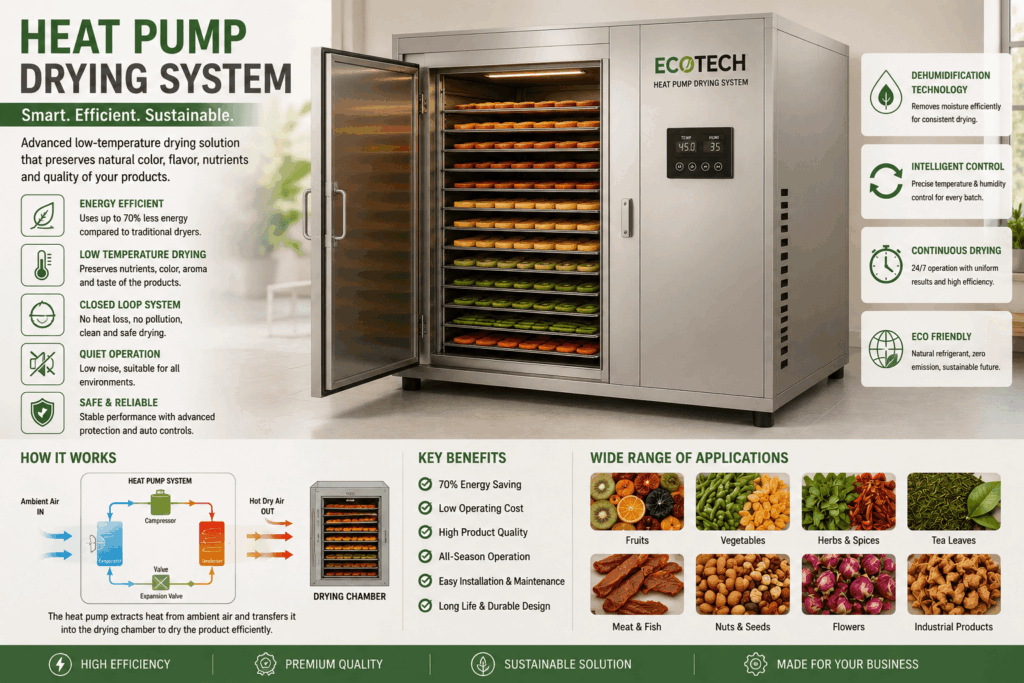
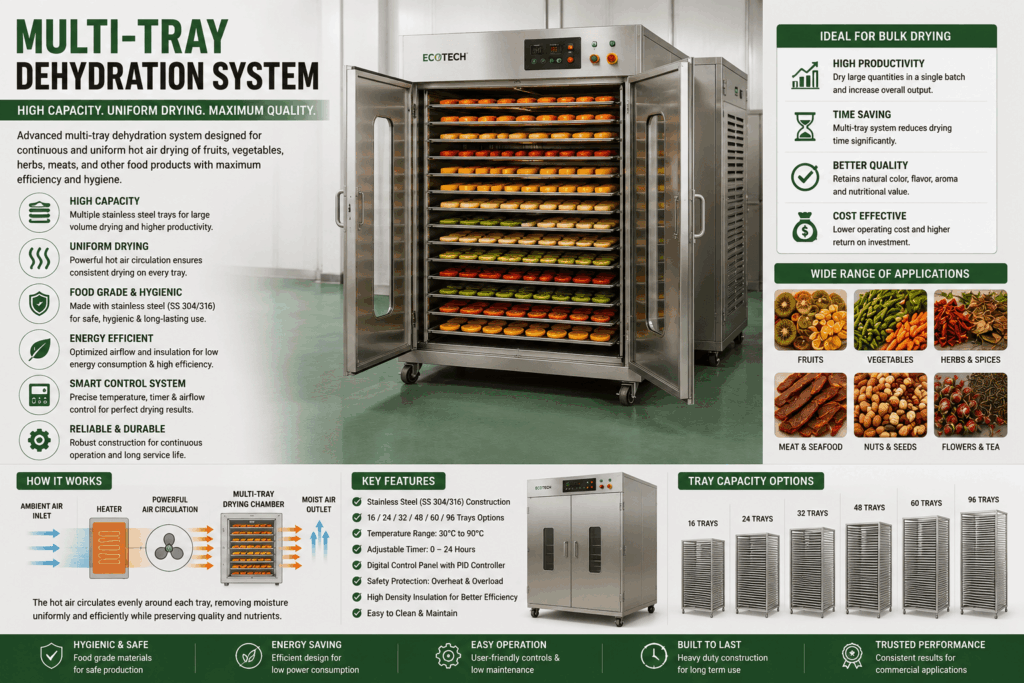
Modern industrial systems include:
- Stainless steel food-grade construction
- Multi-tray drying chambers
- Digital temperature controls
- Uniform airflow distribution
- Energy-efficient thermal design
- Safety cut-off systems
- Modular scalable structure
- Low maintenance engineering
Technical Specifications (Typical Range)
| Parameter | Specification |
| Capacity | 50 kg – 500 kg per batch |
| Temperature Range | 30°C – 90°C |
| Material | Stainless Steel 304 |
| Power Usage | 2 kW – 15 kW |
| Drying Time | 6 – 24 hours |
| Control System | Digital / PLC options |
Industrial Workflow Integration
Typical production line integration:
Raw Material → Washing → Cutting → Blanching → Dehydration → Cooling → Packaging
This integration improves:
- Production efficiency
- Output consistency
- Labor optimization
- Batch scalability
Benefits for Businesses
Using a commercial food dehydrator for startup provides:
- Long shelf-life food products
- Reduced post-harvest losses
- Stable year-round production
- Higher profit margins
- Export-grade product capability
- Reduced dependency on seasonal supply
Energy Efficiency Benefits
Modern heat pump-based systems offer:
- Significant reduction in power consumption
- Heat recovery utilization
- Lower operating cost per kg of product
- Stable performance in long production cycles
- Reduced environmental impact
ROI & Cost-Saving Benefits
Startups benefit from:
- Faster production turnaround
- Lower raw material wastage
- Reduced manpower requirement
- High-value dried product output
- Quick investment recovery cycle
Most startups recover costs within 12–24 months depending on production scale.
Productivity Improvements
- Continuous batch processing capability
- Reduced manual handling
- High output per cycle
- Uniform product quality
- Easy scalability for growing demand
Comparison Section
Traditional vs Modern Systems
| Factor | Traditional Drying | Modern Dehydrator |
| Method | Sun drying | Controlled drying |
| Hygiene | Low | High |
| Speed | Slow | Fast |
| Consistency | Poor | High |
Heat Pump vs Conventional Dryer
| Feature | Heat Pump Dryer | Conventional Dryer |
| Energy Use | Low | High |
| Quality | High retention | Moderate |
| Operating Cost | Low | High |
| Efficiency | High | Medium |
Manual vs Automated Processing
| Factor | Manual | Automated |
| Labor | High | Low |
| Consistency | Low | High |
| Scalability | Limited | High |
Advantages and Disadvantages
Advantages
- High efficiency production
- Export-ready quality output
- Energy savings
- Automation compatibility
- Long-term durability
Disadvantages
- Initial investment required
- Operator training needed
- Requires dedicated space
Buying Guide
When selecting a commercial food dehydrator for startup, consider:
Capacity
Match production demand with machine size.
Material Quality
Stainless steel construction ensures hygiene and durability.
Automation Level
Higher automation improves consistency.
Energy Consumption
Impacts long-term operational cost.
Maintenance
Should allow easy cleaning and servicing.
Scalability
System should support future expansion.
Safety Features
Overheat protection and electrical safety are essential.
Certifications
Ensure food-grade industrial compliance.
Common Mistakes to Avoid
- Choosing non-industrial machines
- Ignoring energy consumption
- Underestimating production scale
- Avoiding maintenance planning
- Focusing only on price instead of ROI
Maintenance Tips
- Clean trays after each batch
- Regular airflow system inspection
- Temperature calibration checks
- Maintain hygienic production environment
- Schedule preventive maintenance
Future Trends & Innovations
The food dehydration industry is evolving toward:
- Smart sensor-based drying control
- IoT-enabled monitoring systems
- Hybrid heat pump technologies
- Solar-assisted drying systems
- Fully automated production lines
- AI-based process optimization
Why Choose ET Solutions
ET Solutions is focused on delivering industrial-grade food processing and drying machinery designed for startups, SMEs, and export manufacturers.
Key strengths:
- Engineering-driven machine design
- Energy-efficient drying systems
- Custom-built production solutions
- Strong industrial reliability
- Startup-friendly scalable systems
- Export-ready manufacturing standards
Conclusion
Choosing the right commercial food dehydrator for startup is a critical decision that directly impacts production quality, energy efficiency, and long-term business success.
Modern heat pump and industrial-grade drying systems allow startups to scale faster, reduce operational costs, and produce export-quality food products consistently.
For any food processing entrepreneur, investing in the right technology is not just a purchase—it is a long-term production strategy.
FAQs
It is an industrial machine used to remove moisture from food for small to medium-scale production.
Heat pump-based systems are the most efficient and scalable.
Typically between 2 kW and 15 kW depending on size.
Yes, industrial dehydrators are widely used for export-grade food products.
Fruits, vegetables, herbs, spices, and snack materials.
They provide better energy efficiency and higher product quality.
Usually 12–24 months depending on production scale.
Basic operator training is recommended for best performance.
Yes, modular systems allow future expansion.
No, industrial designs are built for easy maintenance.
Contact Us: EcoTech Solutions