
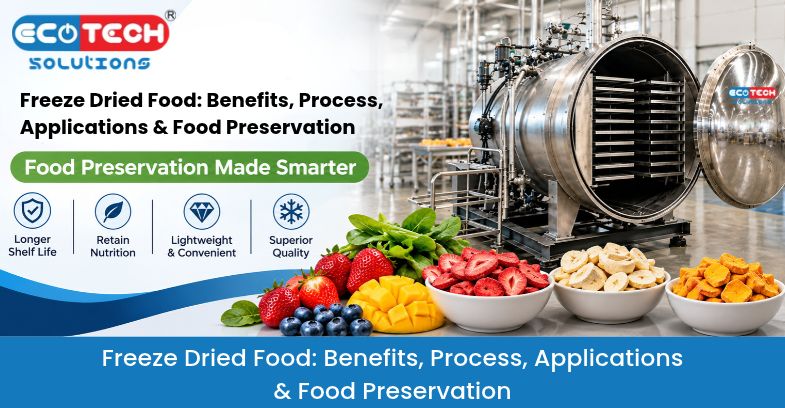
Food preservation has become increasingly important for manufacturers, food processing businesses, and consumers looking for convenient products with longer shelf lives. Traditional preservation methods such as sun drying, hot air drying, and refrigeration have been used for decades. However, modern food processing technologies offer more advanced ways to maintain food quality while reducing moisture content. One such technology is freeze drying.
Freeze drying is an advanced preservation technique that removes moisture from food while helping retain its original flavour, colour, structure, and many heat-sensitive nutrients. It is widely used for processing fruits, vegetables, dairy products, ready-to-eat meals, coffee, and other food ingredients.
As demand for convenient and shelf-stable food products increases, manufacturers are exploring innovative drying solutions to improve product quality and production efficiency. Understanding the technology, its working principles, and its industrial applications can help businesses make informed equipment investments.
This guide explains what is freeze dried food, how the technology works, its advantages, commercial applications, and the role of modern industrial equipment in food preservation.
What Is Freeze Dried Food?
Freeze-drying, also known as lyophilization, is a dehydration process in which food is first frozen and then placed under a vacuum. The frozen water inside the product changes directly into water vapour through a scientific process called sublimation, without passing through the liquid state.
This process removes a significant amount of moisture while helping preserve the food’s physical structure and quality. Unlike conventional drying, which generally uses higher temperatures to evaporate moisture, freeze drying operates under controlled low-temperature and vacuum conditions.
The result is lightweight food that can often be stored for extended periods when properly processed and packaged.
For example, strawberries, mangoes, bananas, peas, mushrooms, and other ingredients can be processed using this technology. Many products can also be rehydrated by adding water, making them useful for food manufacturing, restaurants, and convenience food applications.
How Does the Freeze Dried Food Process Work?
Understanding the freeze dried food process is essential for businesses considering this preservation technology. The method generally involves three major stages: freezing, primary drying, and secondary drying.
1. Freezing the Food Products
The first stage involves reducing the temperature of the food until its moisture content becomes frozen. The freezing conditions depend on the type of food, its composition, size, and processing requirements.
Proper freezing is important because ice crystal formation influences the final product structure. Food manufacturers must select suitable freezing conditions to achieve consistent results.
Fruits and vegetables may require washing, peeling, cutting, or other preparation before entering this stage.
2. Primary Drying Through Sublimation
After freezing, the products are placed inside a vacuum drying chamber. The pressure is reduced, and carefully controlled heat is supplied to support sublimation.
During this stage, frozen water changes directly into vapour without becoming liquid. A condenser collects the removed water vapour, allowing moisture to be separated from the food.
Primary drying generally removes most of the freezable moisture. Temperature, pressure, product thickness, and heat transfer must be carefully controlled to maintain product quality.
3. Secondary Drying
The final stage is called secondary drying or desorption. It removes additional moisture that remains attached to the food structure after primary drying.
The operating conditions are adjusted to achieve the required final moisture content and water activity.
Once drying is complete, the products are carefully unloaded and transferred for suitable packaging. Since dried foods can quickly absorb moisture from the surrounding environment, proper handling is essential.
Major Freeze Dried Food Benefits
Freeze drying offers several advantages over conventional preservation methods, particularly when manufacturers need to maintain the quality and characteristics of valuable food products.
Here are some important freeze dried food benefits for commercial food processing businesses.
1. Extended Shelf Life
Moisture removal reduces water activity, making conditions less favourable for the growth of many microorganisms. This can significantly extend the storage life of properly processed products.
The actual shelf life depends on the original ingredients, final moisture content, packaging quality, storage temperature, and handling practices.
2. Better Retention of Flavour and Aroma
High processing temperatures can affect the natural flavour and aroma of certain ingredients. Freeze drying uses low-temperature sublimation, helping protect many heat-sensitive flavour compounds.
This makes it suitable for fruits, herbs, coffee, and speciality food ingredients where the original sensory characteristics are important.
3. Preservation of Nutritional Quality
Many vitamins, antioxidants, and other sensitive food components can be affected by heat, oxygen, and moisture.
Because freeze drying uses controlled low-temperature conditions, it can help retain more of these components compared with some conventional drying techniques. However, nutritional retention varies according to the food type, preparation, processing conditions, and storage.
4. Lightweight and Convenient Products
Removing moisture considerably reduces the weight of food products. This makes transportation, storage, and handling more convenient for manufacturers and distributors.
Lightweight ingredients are especially useful in instant meals, outdoor food products, emergency food supplies, and packaged snacks.
5. Improved Rehydration Properties
Many freeze-dried products maintain a porous structure that allows them to absorb water relatively quickly.
This feature is useful for instant soups, fruit ingredients, vegetables, and ready-to-prepare food products.
6. Reduced Dependence on Refrigeration
Properly processed and moisture-protected products can often be stored at room temperature without continuous refrigeration.
This can simplify distribution and storage requirements. However, appropriate packaging and storage conditions remain essential for maintaining food quality and safety.
Popular Applications of Freeze Drying in the Food Industry
Freeze drying is used across different food processing sectors because it can preserve a wide variety of ingredients.
- Fruit Processing
Fruits such as strawberries, blueberries, mangoes, bananas, apples, and pineapples are popular candidates for freeze drying.
They can be processed into lightweight pieces used in breakfast cereals, bakery products, confectionery, snack mixes, and instant beverages.
- Vegetable Processing
Vegetables such as carrots, peas, spinach, sweet corn, mushrooms, and potatoes can be processed using this technology.
Food manufacturers use dried vegetable ingredients in instant noodles, soup mixes, ready-to-cook products, and seasoning blends.
- Dairy Products
Milk, yoghurt cultures, cheese ingredients, and other dairy-based products can be processed through freeze drying when suitable formulations and processing conditions are used.
The technology is particularly valuable for ingredients that require moisture reduction while maintaining functional properties.
- Coffee and Beverage Ingredients
Instant coffee is one of the established commercial applications of freeze drying. The process helps produce convenient coffee granules while retaining important flavour and aroma characteristics.
Certain fruit powders, beverage ingredients, and speciality drink formulations can also benefit from this technology.
- Ready-to-Eat and Instant Meals
Manufacturers can process complete meal components, including vegetables, grains, sauces, and selected protein ingredients.
These products are useful for camping meals, travel food, emergency supplies, and convenient meal preparation.
Why Is a Freeze Dried Food Machine Important for Manufacturers?
Selecting the right freeze dried food machine is an important decision for businesses planning to enter the commercial food preservation industry.
Industrial equipment helps manufacturers manage important processing parameters, including temperature, vacuum pressure, drying time, and moisture removal.
A suitable machine can support:
- Consistent processing conditions across production batches.
- Controlled freezing and drying operations.
- Better management of final moisture levels.
- Processing of different food ingredients.
- Improved production planning and workflow.
- Reliable product quality when operated and maintained correctly.
Before purchasing equipment, businesses should evaluate their production capacity, product categories, required moisture levels, available utilities, installation space, and operational budget.
The machine should also be selected according to the intended application rather than choosing equipment based only on its capacity.
Choosing the Right Vacuum Freeze Drying Equipment
Industrial freeze drying requires specialised equipment that combines refrigeration, vacuum technology, heating systems, and moisture collection components.
A commercial system generally includes a drying chamber, product trays or shelves, a refrigeration system, vacuum pumps, a condenser, and a control system.
Businesses evaluating equipment should consider several factors:
Production Capacity: Determine the quantity of raw material to be processed per batch and the expected daily production requirement.
Temperature Control: Consistent temperature management is important for protecting food structure and achieving the desired drying results.
Vacuum Performance: The vacuum system must maintain suitable operating pressure throughout the drying cycle.
Energy Consumption: Freeze drying can require considerable energy. Compare the expected operating costs and energy requirements before investing.
Maintenance and Technical Support: Regular maintenance, cleaning, and access to technical assistance help maintain equipment performance.
Product Flexibility: Manufacturers processing multiple ingredients should consider whether the equipment can accommodate different product types and processing requirements.
Businesses looking for specialised industrial solutions can explore the Vacuum Freeze Dryer range from ET Solutions.
How to Identify Reliable Freeze Dried Food Manufacturers in India
India has a growing food processing sector with opportunities in fruit preservation, vegetable processing, instant foods, speciality ingredients, and packaged snacks.
Businesses searching for freeze dried food manufacturers in india should assess product quality, processing capabilities, food safety practices, production capacity, and packaging standards.
Here are some factors worth evaluating before selecting a manufacturing partner:
- Processing Infrastructure: Check whether the manufacturer uses suitable industrial freeze-drying technology and maintains consistent production conditions.
- Quality Control: Review testing procedures for moisture content, water activity, microbiological quality, and product consistency.
- Raw Material Sourcing: Reliable sourcing of fresh and suitable ingredients helps maintain the quality of finished products.
- Packaging Standards: Moisture-resistant packaging is important because freeze-dried products can absorb moisture from the atmosphere.
- Production Capacity: Ensure that the supplier can meet your expected order quantities and delivery schedules.
- Certifications and Compliance: Verify applicable food safety registrations, certifications, and regulatory requirements rather than relying on unsupported marketing claims.
When comparing freeze dried food manufacturers in india, businesses should also request product samples and evaluate flavour, appearance, texture, rehydration performance, and shelf-life documentation.
For entrepreneurs planning to establish their own processing facility, investing in appropriate machinery can provide greater control over production and product development.
Role of ET Solutions in Industrial Food Processing
Choosing suitable machinery is essential for food processing businesses that want to develop reliable preservation operations.
ET Solutions provides industrial equipment solutions for businesses exploring advanced processing technologies. Its vacuum freeze-drying equipment offerings can be explored through the company’s product pages.
Businesses interested in industrial processing solutions can also visit ET Solutions – Heat Pump Manufacturer to learn more about its equipment range.
For specialised applications, the Vacuum Freeze Drying Machine page provides another resource for exploring the company’s freeze-drying equipment.
Before selecting a system, manufacturers should discuss their raw materials, required batch capacity, product specifications, and production objectives with the equipment supplier.
Food Safety, Packaging and Storage Considerations
Although freeze drying removes a large amount of moisture, it should not be treated as a sterilisation process.
Some microorganisms can survive the drying process and become active again when moisture is introduced. Therefore, manufacturers must follow appropriate food safety procedures throughout preparation, processing, handling, and packaging.
Important considerations include:
- Use fresh, suitable, and hygienically handled raw materials.
- Follow appropriate washing and preparation procedures.
- Prevent cross-contamination during processing.
- Validate the required processing and food safety controls.
- Monitor final moisture content and water activity.
- Use suitable moisture-barrier packaging.
- Protect products from oxygen, light, and humidity where necessary.
- Store finished products under recommended conditions.
Packaging options may include laminated pouches, sealed containers, and other suitable moisture-resistant materials. Oxygen absorbers or nitrogen flushing may also be considered depending on the food product and packaging requirements.
Proper packaging is essential because even a well-processed product can lose quality if exposed to moisture during storage or transportation.
Future Opportunities for Freeze-Dried Food Processing in India
The Indian food processing sector offers opportunities for businesses looking to develop value-added products from locally available agricultural produce.
Fruits, vegetables, herbs, dairy ingredients, and speciality food products can be explored for freeze-drying applications.
Food entrepreneurs can consider developing:
- Freeze-dried fruit snacks.
- Vegetable ingredients for instant meals.
- Premium fruit toppings.
- Instant beverage ingredients.
- Lightweight travel and camping meals.
- Speciality food ingredients for bakery and confectionery applications.
As consumer preferences evolve, manufacturers can explore new product formats that combine convenience, quality, and longer storage potential.
However, commercial success depends on more than technology. Businesses must also consider raw material availability, equipment investment, energy costs, production efficiency, food safety, packaging, distribution, and customer demand.
Conclusion
Freeze drying is an advanced food preservation technology that helps remove moisture while maintaining many of the original characteristics of food products. Its ability to preserve flavour, colour, structure, and heat-sensitive nutrients makes it valuable for fruit processing, vegetables, dairy ingredients, coffee, and ready-to-eat meals.
Understanding the process, evaluating equipment requirements, and following proper food safety and packaging practices are essential for achieving consistent results.
For food manufacturers and entrepreneurs exploring industrial preservation solutions, selecting suitable machinery is an important step towards building an efficient processing operation. ET Solutions offers equipment options for businesses interested in exploring vacuum freeze-drying technology and other industrial solutions.