
Water heating is one of the largest contributors to household and commercial electricity consumption. Whether it is a residential villa, apartment complex, hotel, hospital, or educational institution, the demand for reliable hot water remains constant throughout the year. However, rising electricity tariffs have forced property owners and facility managers to look for more energy-efficient alternatives to traditional electric geysers.
This is where the Domestic Heat Pump Cost in India becomes an important consideration. While many buyers initially focus on the purchase price, experienced consultants evaluate a water heating system based on long-term operating costs, energy savings, maintenance requirements, and return on investment (ROI).
A domestic heat pump may require a higher upfront investment than a conventional geyser, but its ability to deliver significant energy savings over many years makes it one of the most cost-effective hot water solutions available today.
In this guide, we explain domestic heat pump pricing, installation costs, energy savings, ROI calculations, and how to determine whether a heat pump is the right investment for your property.
What Is a Domestic Heat Pump?
A domestic heat pump is an energy-efficient water heating system that extracts heat from the surrounding air and transfers it into water.
Unlike conventional electric geysers that generate heat directly using electrical resistance elements, a heat pump moves existing heat from the environment. This process requires significantly less electricity while producing the same amount of hot water.
Because of this technology, heat pumps are increasingly being adopted across:
- Residential homes
- Luxury villas
- Apartment buildings
- Hotels and resorts
- Hospitals
- Hostels
- Educational institutions
- Commercial facilities
The primary advantage is simple: more hot water with substantially lower electricity consumption.
How Does a Domestic Heat Pump Work?
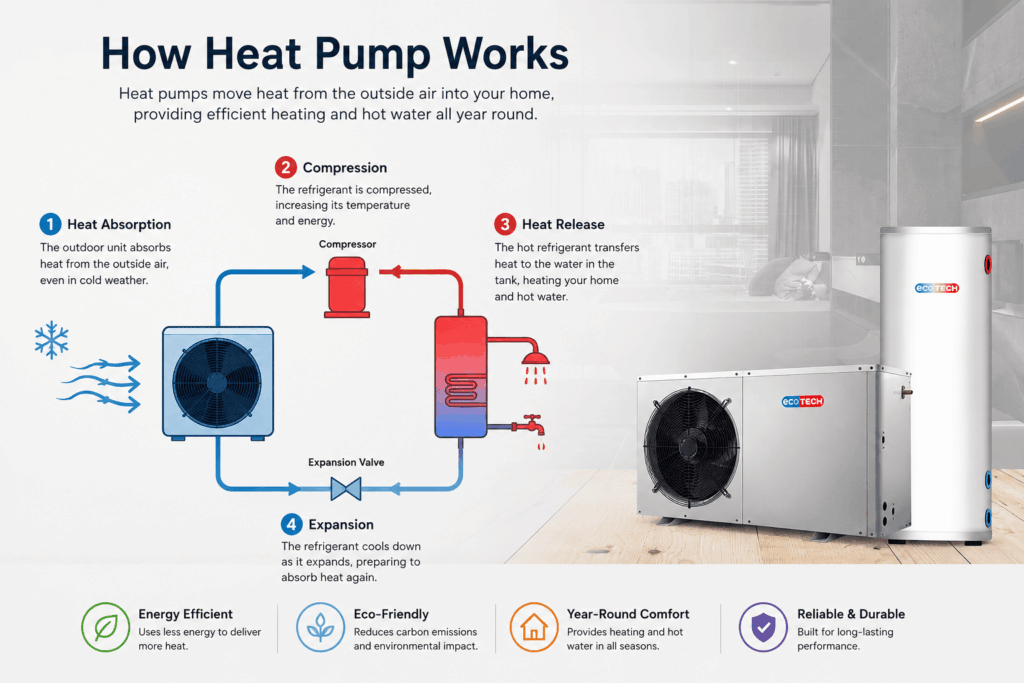
A heat pump operates using principles similar to air conditioning and refrigeration systems.
Step-by-Step Process
1. Heat Absorption
The evaporator coil absorbs heat from ambient air.
2. Refrigerant Compression
The refrigerant is compressed, increasing its temperature significantly.
3. Heat Transfer
The hot refrigerant transfers heat to water stored inside the tank.
4. Hot Water Storage
The heated water is stored and distributed as required.
5. Continuous Operation
The cycle repeats automatically to maintain water temperature.
This process enables heat pumps to produce multiple units of heat energy for every unit of electricity consumed.
Domestic Heat Pump Cost in India: What Should You Expect?
One of the most common questions buyers ask is:
“How much does a domestic heat pump cost in India?”
The answer depends on capacity, technology, hot water demand, installation requirements, and application type.
Typical Cost Range
| Capacity | Suitable For | Approximate Cost Range |
| 100–150 Litres | Small Families | ₹80,000 – ₹1,50,000 |
| 200–300 Litres | Medium Homes | ₹1,20,000 – ₹2,50,000 |
| 300–500 Litres | Villas & Apartments | ₹2,00,000 – ₹4,00,000 |
| Commercial Systems | Hotels & Hospitals | Project-Based Pricing |
Actual pricing varies depending on specifications, insulation quality, compressor technology, and installation complexity.
Factors That Influence Heat Pump Price
Several factors affect the final investment.
Capacity Requirements
Larger hot water demand requires larger storage capacity and higher-capacity compressors.
Energy Efficiency Rating
Higher efficiency systems may cost more initially but deliver better lifetime savings.
Compressor Quality
Premium compressors generally provide:
- Better reliability
- Lower maintenance
- Longer lifespan
- Improved efficiency
Tank Construction
High-quality tanks often feature:
- Corrosion-resistant materials
- Advanced insulation
- Long service life
Installation Conditions
Installation costs may vary depending on:
- Roof access
- Plumbing modifications
- Electrical upgrades
- Water storage integration
Heat Pump vs Electric Geyser: Cost Comparison
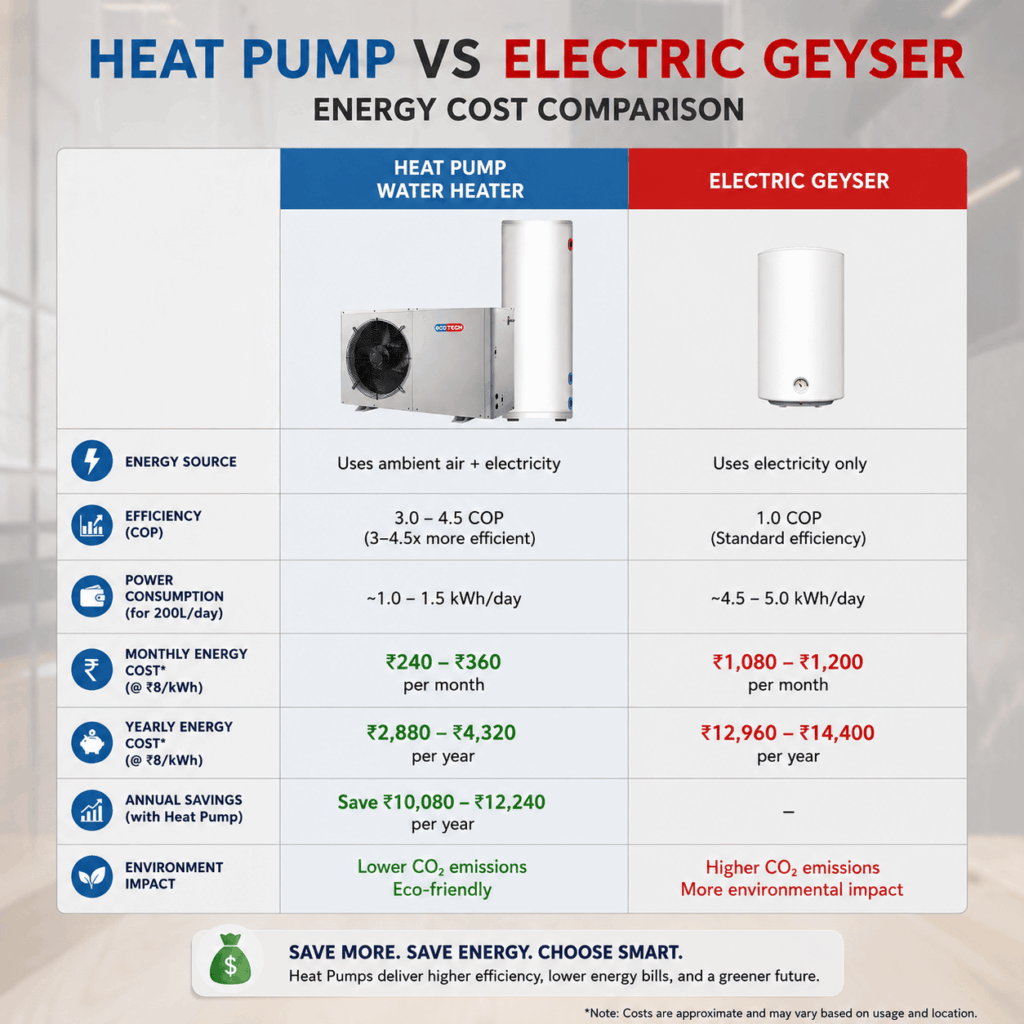
Many buyers compare heat pumps with traditional geysers solely based on purchase price. This approach overlooks long-term operational expenses.
Comparison Table
| Parameter | Electric Geyser | Domestic Heat Pump |
| Initial Cost | Lower | Higher |
| Electricity Consumption | High | Low |
| Operating Cost | High | Low |
| Efficiency | Moderate | Very High |
| Environmental Impact | Higher | Lower |
| Lifespan | 5–8 Years | 10–15+ Years |
| Maintenance | Moderate | Low |
| ROI Potential | Limited | Excellent |
While geysers appear economical initially, long-term operating expenses can significantly exceed the initial savings.
Heat Pump vs Solar Water Heater
Solar water heaters are another popular option.
Solar Water Heater Advantages
- Renewable energy source
- Low operating cost
Solar Water Heater Limitations
- Weather dependency
- Reduced performance during cloudy periods
- Larger installation area
Heat Pump Advantages
- Operates year-round
- Consistent hot water supply
- Weather-independent operation
- Compact installation footprint
For properties requiring uninterrupted hot water, heat pumps often provide greater reliability.
Electricity Consumption of Domestic Heat Pumps
One of the strongest selling points of heat pumps is energy efficiency.
Traditional electric geysers convert electricity directly into heat.
Heat pumps transfer heat instead of generating it.
As a result, many systems achieve significantly lower electricity consumption compared to conventional water heating technologies.
Benefits include:
- Reduced monthly electricity bills
- Lower peak power demand
- Improved energy management
- Reduced carbon footprint
How Much Money Can You Save Every Year?
Savings depend on:
- Daily hot water demand
- Existing water heating system
- Electricity tariff
- Usage pattern
Properties with high hot water consumption typically experience the fastest payback periods.
Examples include:
- Hotels
- Hospitals
- Hostels
- Large villas
- Apartment complexes
The greater the hot water requirement, the more substantial the potential savings.
Understanding Heat Pump ROI and Payback Period
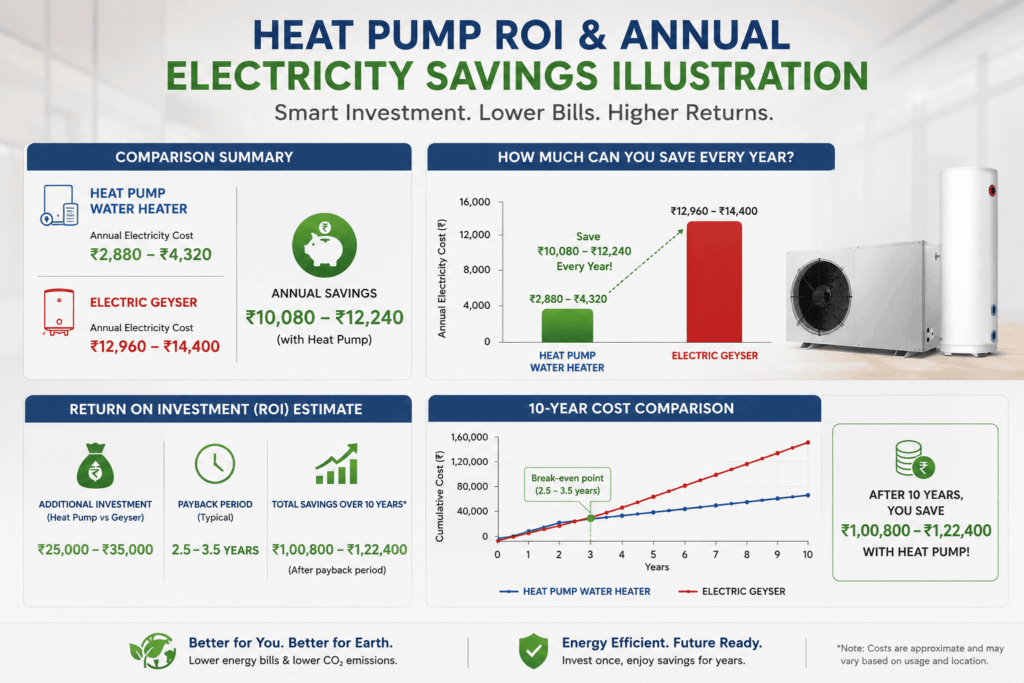
When evaluating a heat pump investment, buyers should focus on total lifecycle cost rather than upfront purchase price.
ROI Factors
Initial Equipment Cost
The purchase and installation investment.
Electricity Savings
Reduced monthly operating expenses.
Maintenance Savings
Lower maintenance compared to many conventional systems.
Equipment Lifespan
Longer service life improves overall return.
Typical Payback Period
Depending on usage intensity and electricity rates, many users recover their investment through energy savings over time.
High-consumption facilities generally achieve faster ROI compared to low-demand households.
Installation Cost and Requirements
Proper installation directly affects performance.
Typical Requirements
Suitable Installation Space
Adequate airflow around the unit is essential.
Water Connections
Integration with existing plumbing systems.
Electrical Supply
Appropriate power connection and protection systems.
Drainage
Condensate drainage arrangement.
Structural Support
Proper mounting for long-term stability.
Professional installation ensures:
- Maximum efficiency
- Reliable operation
- Reduced maintenance issues
- Longer equipment life
Best Applications for Domestic Heat Pumps
Homes and Villas
Ideal for families seeking long-term electricity savings and uninterrupted hot water.
Apartment Buildings
Centralized hot water systems can significantly reduce operating expenses.
Hotels and Resorts
High daily hot water demand creates strong ROI opportunities.
Hospitals
Reliable hot water is essential for patient care and sanitation.
Educational Institutions
Hostels and campus facilities can benefit from reduced utility costs.
Benefits of Installing a Domestic Heat Pump
Lower Electricity Bills
One of the biggest advantages for residential and commercial users.
Long-Term Savings
Reduced operating expenses year after year.
Consistent Hot Water Supply
Reliable performance across seasons.
Eco-Friendly Operation
Reduced energy consumption contributes to sustainability goals.
Longer Equipment Life
Quality heat pumps can provide dependable operation for many years.
Reduced Carbon Emissions
Lower electricity consumption helps reduce environmental impact.
Common Mistakes Buyers Make
Avoid these costly errors.
Choosing Based Only on Price
The cheapest system is not always the most economical over its lifespan.
Incorrect Sizing
Undersized systems may struggle to meet demand.
Ignoring Energy Efficiency
Efficiency directly impacts operating costs.
Poor Installation Practices
Improper installation reduces performance and reliability.
Overlooking After-Sales Support
Technical support is critical for long-term satisfaction.
How to Choose the Right Heat Pump
Consider the following factors before purchasing.
Capacity
Match system size with actual hot water demand.
Build Quality
Look for durable, corrosion-resistant construction.
Energy Efficiency
Higher efficiency means lower operating costs.
Compressor Reliability
A high-quality compressor improves longevity.
Safety Features
Ensure adequate protection systems are included.
Service Support
Choose a manufacturer with strong technical assistance.
Scalability
Future expansion capability can be valuable for growing facilities.
Why Choose ET Solutions for Domestic Heat Pumps?
ET Solutions focuses on delivering reliable and energy-efficient water heating solutions designed for Indian operating conditions.
Advantages of Working with ET Solutions
- Energy-efficient heat pump technology
- Reliable performance
- Professional installation support
- Technical consultation
- Customized solutions
- Long-term service assistance
- Quality-focused engineering
- Cost-effective ownership experience
Whether your requirement is residential, commercial, or institutional, ET Solutions can recommend the most suitable solution based on your hot water demand and energy goals.
Future of Energy-Efficient Water Heating in India
India’s focus on energy conservation and sustainable infrastructure is driving increased adoption of advanced water heating technologies.
Future trends include:
- Smart heat pump controls
- IoT-based monitoring
- Enhanced compressor efficiency
- Improved insulation technologies
- Integration with renewable energy systems
- Commercial-scale centralized heating solutions
As electricity costs continue to rise, heat pumps are expected to become a preferred water heating technology across residential and commercial sectors.
Conclusion
When evaluating the Domestic Heat Pump Cost in India, it is important to look beyond the initial purchase price. A heat pump is not simply a water heater—it is a long-term energy-saving investment.
Compared to traditional electric geysers, heat pumps offer:
- Lower electricity consumption
- Reduced operating costs
- Long equipment life
- Improved sustainability
- Consistent hot water availability
- Strong return on investment
For homeowners, hotels, hospitals, educational institutions, and commercial properties, investing in a high-quality domestic heat pump can lead to significant savings and dependable performance for years to come.
Looking for the Right Domestic Heat Pump Solution?
Whether you are planning a new home, upgrading an existing water heating system, or evaluating energy-efficient solutions for a hotel, hospital, apartment complex, or commercial property, ET Solutions can help.
Our team provides:
✔ Heat pump selection guidance
✔ Customized sizing recommendations
✔ Installation support
✔ Technical consultation
✔ Energy savings assessment
✔ Commercial and residential solutions
✔ Bulk project quotations
✔ Long-term maintenance support
Contact ET Solutions today to discuss your hot water requirements and discover how a domestic heat pump can reduce operating costs while delivering reliable year-round hot water.
Frequently Asked Questions
The cost typically ranges from ₹80,000 to ₹4,00,000 or more depending on capacity, technology, and installation requirements.
Yes. Heat pumps generally consume significantly less electricity than conventional electric geysers.
Most quality systems can provide reliable service for 10–15 years or longer with proper maintenance.
Yes. Modern heat pumps are designed to operate efficiently in a wide range of climatic conditions.
Absolutely. They are suitable for individual apartments as well as centralized residential systems.
Savings depend on usage patterns, but heat pumps are widely recognized for their high energy efficiency.
Contact Us: EcoTech Solutions