
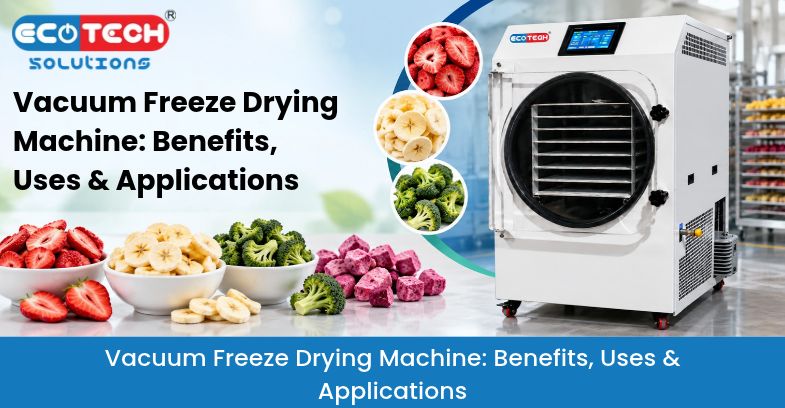
Modern industries require advanced drying technologies that can remove moisture while maintaining the quality, appearance, and stability of sensitive materials. Food processing companies, pharmaceutical manufacturers, biotechnology laboratories, and research organizations often work with products that can be damaged by conventional high-temperature drying methods. This is where vacuum freeze drying technology becomes valuable.
A vacuum freeze drying machine uses low temperatures and controlled vacuum conditions to remove frozen moisture through a process known as sublimation. Instead of converting ice into liquid water before removing it, this technology allows ice to change directly into water vapour. This helps preserve the structure and many quality characteristics of heat-sensitive products.
From preserving fruits and vegetables to processing pharmaceutical ingredients and biological samples, freeze drying has become an important technology for applications where product quality matters. Selecting suitable equipment requires an understanding of its operating principle, benefits, industrial applications, and operating requirements.
What Is a Vacuum Freeze Drying Machine?
A vacuum freeze drying machine is industrial or laboratory equipment designed to remove moisture from previously frozen materials under reduced pressure. Also known as lyophilization equipment, it is used when conventional drying methods may cause undesirable changes in a product’s texture, colour, aroma, or temperature-sensitive components.
The process combines refrigeration, vacuum technology, controlled heating, and moisture collection. The material is frozen before drying begins. A vacuum is then created inside the chamber, allowing the ice to sublime under suitable conditions. A cold condenser captures the resulting water vapour and prevents it from returning to the product.
Unlike conventional hot-air drying, this process does not depend primarily on evaporating liquid moisture from a warm product. Instead, it removes ice directly as vapour, helping retain the material’s original structure.
Equipment selection depends on several factors, including the type of material, batch size, required final moisture content, processing time, and intended storage conditions.
How Does Vacuum Freeze Drying Work?
Understanding the operating process helps businesses evaluate whether this technology is suitable for their production requirements. The process generally involves three main stages.
1. Freezing the Product
The material is cooled until its freezable moisture becomes ice. Proper freezing is essential because it affects the product structure and the efficiency of subsequent drying stages.
For food products, preparation may involve washing, cutting, portioning, or other suitable processing steps. Pharmaceutical and laboratory materials may require carefully controlled preparation procedures.
2. Primary Drying Through Sublimation
After freezing, the drying chamber is evacuated to achieve the required low pressure. Under appropriate temperature and pressure conditions, heat is supplied in a controlled manner, allowing ice to transform directly into water vapour.
The vapour moves away from the product and collects on a colder condenser surface. This stage removes most of the freezable moisture.
3. Secondary Drying
Some moisture may remain bound to the material after primary drying. Secondary drying gradually removes additional moisture under controlled conditions.
The final moisture content depends on the product, process settings, equipment design, and intended storage requirements. Once the cycle is complete, the dried material can be removed and packaged using suitable moisture-protective packaging.
Careful control of temperature, pressure, and processing time helps achieve consistent results across batches.
Key Benefits of Vacuum Freeze Drying Technology
1. Preservation of Product Quality
One of the main advantages of freeze drying is its ability to protect many heat-sensitive product characteristics. Because the process removes moisture from a frozen material under vacuum, it can help preserve colour, aroma, texture, and certain sensitive components better than some conventional drying methods.
The actual results depend on the material and the processing conditions.
2. Improved Storage Stability
Removing moisture can help reduce microbial growth and certain deterioration processes when the product is processed appropriately. This can support longer storage periods and simplify transportation.
However, freeze drying does not automatically sterilize a product. Appropriate hygiene, validated processing where required, suitable packaging, and proper storage remain essential.
3. Better Rehydration Properties
Freeze-dried products often develop a porous structure as ice is removed. When exposed to water, this structure can help the material absorb moisture again.
This characteristic is useful for instant foods, ingredients, and other products that must be reconstituted before use.
4. Reduced Product Weight
Moisture removal significantly reduces the weight of many products. This can help businesses lower the weight of materials transported and stored, depending on packaging and distribution requirements.
Lightweight products are particularly useful for emergency food supplies, outdoor meals, and applications involving long-distance transportation.
5. Support for High-Value Products
Some materials require careful processing to preserve properties that contribute to their commercial value. Freeze drying can be suitable for selected premium food products, biological materials, pharmaceutical ingredients, and research samples.
A properly selected vacuum freeze drying machine can help manufacturers develop products for markets where quality, stability, and controlled processing are important.
Major Industrial Applications
Food Processing Industry
Food processing is a major application area for freeze drying. Selected fruits, vegetables, herbs, coffee products, dairy ingredients, and prepared foods can be processed using this technology.
Examples include strawberries, mango pieces, mushrooms, herbs, and instant beverage ingredients. The process can help preserve flavour and appearance while producing lightweight products that are convenient to package and transport.
Food manufacturers should evaluate raw-material preparation, batch capacity, moisture targets, food safety requirements, and packaging before investing in equipment.
Pharmaceutical Industry
Pharmaceutical production uses freeze drying for selected formulations that are sensitive to moisture or temperature. Certain injectable medicines, biological products, and other formulations may benefit from the stability achieved through carefully validated lyophilization processes.
In these applications, equipment selection must consider process control, cleanability, material compatibility, documentation, and applicable regulatory requirements.
Not every pharmaceutical product is suitable for freeze drying, so process development and validation are important.
Biotechnology and Laboratory Research
Biotechnology organizations and research laboratories may use freeze drying to preserve selected biological samples, enzymes, cultures, and analytical materials.
The process can help prepare materials for storage, transport, and later reconstitution. Requirements vary significantly according to the sample and research objective.
Laboratory-scale systems may be appropriate for development work, while larger systems may be needed when a process moves towards commercial production.
Nutraceuticals and Natural Ingredients
Certain vitamins, botanical ingredients, probiotics, and other sensitive materials may be processed using freeze drying when the formulation and intended use support this method.
Manufacturers must assess ingredient stability, final moisture requirements, and packaging conditions to protect product quality throughout its intended shelf life.
Research and Specialty Applications
Freeze drying may also be used for selected specialty chemicals, reference materials, and other products that require controlled moisture removal. Suitability depends on the physical and chemical characteristics of the material.
What Is a Vacuum Dryer, and How Is It Different From a Freeze Dryer?
The question what is vacuum dryer is important for businesses comparing different industrial drying technologies.
A conventional vacuum dryer removes moisture by reducing the pressure around a wet material. This lowers the boiling point of the liquid, allowing moisture to evaporate at a lower temperature than it might under atmospheric pressure.
A freeze dryer, in contrast, first freezes the material and then removes ice through sublimation under vacuum. The distinction is important because the two technologies are designed for different process requirements.
Conventional vacuum drying may suit heat-sensitive materials that can tolerate moisture evaporation from a liquid phase. Freeze drying may be more appropriate when maintaining a porous structure, rehydration performance, or selected temperature-sensitive characteristics is especially important.
When asking what is vacuum dryer technology suitable for, manufacturers should consider the material’s heat sensitivity, moisture content, solvent characteristics, final product specifications, and production costs.
Neither method is universally better. The most suitable solution depends on the intended outcome and the material being processed.
How to Choose the Right Equipment
Choosing equipment requires more than comparing machine dimensions or advertised capacity. Businesses should evaluate the complete production process.
Consider these factors before purchasing:
- Processing capacity: Determine the required batch size and expected daily or annual production volume.
- Product characteristics: Assess moisture content, freezing behaviour, heat sensitivity, and material composition.
- Temperature and pressure control: Confirm that the system can maintain the operating conditions required for the product.
- Condenser performance: Ensure that the condenser can handle the expected moisture load.
- Automation: Evaluate monitoring, alarms, recipe control, and data recording where needed.
- Cleaning and maintenance: Review accessibility, cleaning procedures, spare parts, and service support.
- Operating costs: Consider electricity consumption, refrigeration requirements, labour, maintenance, and cycle duration.
- Packaging requirements: Plan for moisture protection after drying to help maintain product stability.
Pilot testing can help establish suitable process parameters before a business invests in large-scale production equipment.
Vacuum Freeze Dryer Price in India: What Affects the Cost?
The vacuum freeze dryer price in India depends on equipment capacity, chamber design, refrigeration performance, vacuum pump configuration, automation, and the intended application.
Laboratory units generally have different specifications from commercial food-processing systems or industrial production equipment. Pharmaceutical applications may require additional control, documentation, and cleanability features that influence the overall investment.
When comparing quotations, businesses should review the following:
- Batch capacity and usable shelf area
- Operating temperature and vacuum range
- Condenser capacity and refrigeration system
- Automatic controls and monitoring features
- Installation, commissioning, and operator training
- Warranty, maintenance, and after-sales service
- Power requirements and estimated operating costs
The vacuum freeze dryer price in India should therefore be evaluated against the complete system configuration rather than the purchase price alone. Requesting a detailed quotation based on the intended product and production volume can help make comparisons more meaningful.
Why Choose an Experienced Vacuum Freeze Dryer Manufacturer?
Working with an experienced vacuum freeze dryer manufacturer can help businesses identify equipment that matches their process requirements. A suitable supplier should understand the relationship between product characteristics, freezing conditions, vacuum performance, condenser capacity, and final moisture targets.
Before selecting a supplier, ask about equipment specifications, application testing, installation support, maintenance requirements, and access to replacement components.
An experienced vacuum freeze dryer manufacturer should also provide clear technical information so that buyers can assess the equipment against their production objectives. For specialized food or pharmaceutical applications, confirm whether the supplier can support the relevant validation and documentation requirements.
Businesses comparing the vacuum freeze dryer price in India should request quotations with clearly defined specifications, inclusions, exclusions, and service terms.
ET Solutions offers industrial equipment and energy-related solutions. Explore its Vacuum Freeze Dryer page to learn more about its offering, or visit the Heat Pump Manufacturer website to explore the company’s broader product range.
Energy Efficiency and Sustainable Industrial Processing
Energy consumption is an important consideration when evaluating any industrial drying system. Freeze drying can require substantial energy because the process involves freezing, refrigeration, vacuum generation, and controlled heating over a processing cycle.
Businesses can improve operational planning by selecting an appropriately sized system, optimizing batch loading, maintaining refrigeration and vacuum components, and developing efficient process cycles.
Explore ET Solutions’ information on Energy Efficiency for additional insights into sustainable industrial practices.
A complete efficiency assessment should consider energy use per unit of finished product, processing time, product yield, maintenance, and quality requirements. The lowest initial equipment cost does not necessarily translate into the lowest long-term operating cost.
Frequently Asked Questions (FAQs)
1. What is a vacuum freeze drying machine used for?
It is used to remove moisture from frozen materials under vacuum. Applications include selected food products, pharmaceutical formulations, biological samples, laboratory materials, and specialty ingredients.
2. What is vacuum dryer technology?
When people ask what is vacuum dryer technology, they are generally referring to a drying process that reduces pressure to remove moisture at lower temperatures. A freeze dryer is a specialized system that removes frozen water through sublimation.
3. How does a vacuum freeze dryer work?
The material is frozen, the chamber pressure is reduced, and controlled heat allows ice to sublime into water vapour. A cold condenser captures the vapour, and secondary drying removes additional moisture.
4. What determines the vacuum freeze dryer price in India?
Capacity, refrigeration and vacuum systems, automation, chamber design, application requirements, installation, and after-sales support all affect the final quotation.
5. How do I select a vacuum freeze dryer manufacturer?
Compare technical specifications, product-testing support, equipment quality, service availability, maintenance requirements, and experience with your intended application.
6. Is freeze drying better than conventional drying?
Freeze drying can provide better retention of selected product characteristics and improved rehydration properties for suitable materials. However, it may involve higher equipment costs and longer processing cycles. The best method depends on the product and commercial objectives.
7. Does freeze drying make food safe indefinitely?
No. Freeze drying reduces moisture but does not guarantee sterility or indefinite shelf life. Safe processing, appropriate packaging, and recommended storage conditions are still necessary.
8. Is freeze drying suitable for every material?
No. Suitability depends on freezing behaviour, heat sensitivity, composition, desired product quality, and process economics. Testing is recommended for unfamiliar materials.
Conclusion
Vacuum freeze drying is an advanced moisture-removal technology that can help preserve the quality and structure of selected heat-sensitive materials. Its applications across food processing, pharmaceuticals, biotechnology, nutraceuticals, and research make it valuable for businesses seeking specialized drying solutions.
Before investing, manufacturers should evaluate capacity, product requirements, process performance, energy consumption, maintenance, and total ownership costs. Comparing technical specifications and conducting application trials can help identify the right equipment for long-term production needs.
Contact Us: EcoTech Solutions