
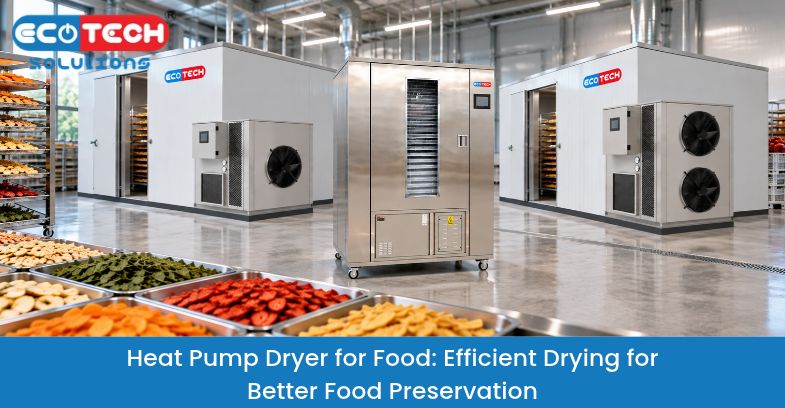
Food preservation has evolved significantly with advances in drying technology. Traditional methods such as sun drying and conventional hot-air drying can still be useful, but modern food processors increasingly need better control over temperature, humidity, energy consumption, hygiene, and drying consistency. This is where a heat pump dryer for food can provide an efficient and controlled approach to food dehydration.
A heat pump drying system removes moisture from food while recovering and reusing heat within the drying process. Instead of continuously generating and exhausting heated air, the system can circulate conditioned air through the drying chamber. This approach can help businesses achieve consistent drying while reducing unnecessary energy loss.
From fruits and vegetables to herbs, spices, and other food products, heat pump drying technology can support commercial and industrial food preservation. When properly designed and operated, it can help maintain product quality while extending shelf life and reducing dependence on weather conditions.
What Is a Heat Pump Dryer for Food?
A heat pump dryer for food is a controlled food-drying system that uses heat pump technology to remove moisture from food products. The basic process involves circulating warm, relatively dry air through a drying chamber. As the air absorbs moisture from the food, it is returned to the heat pump system, where moisture is removed and heat can be recovered for continued drying.
This closed or semi-closed drying approach is different from simple open-air drying. The temperature, airflow, and humidity can be controlled according to the product and the desired drying characteristics.
The technology can be particularly useful for food processors that need repeatable results. Drying conditions can influence color, texture, aroma, nutritional characteristics, and final moisture content. Controlled drying therefore provides an advantage over methods that depend heavily on outdoor temperature and humidity.
How Does a Heat Pump Dryer Work?
The working principle is relatively straightforward. A heat pump system transfers heat rather than simply producing heat through direct combustion or resistance heating.
During food drying, air passes through the drying chamber and comes into contact with the food. The air absorbs moisture from the product. The humid air then moves through the heat pump system, where moisture is removed. Heat from the system is recovered and used to warm the circulating air again.
This creates a continuous drying cycle:
- Food products are prepared and placed on drying trays.
- Conditioned air circulates through the drying chamber.
- Warm air absorbs moisture from the food.
- Moist air returns to the heat pump system.
- Moisture is removed from the air.
- Heat is recovered and reused.
- Conditioned air is circulated back through the chamber.
The exact temperature and drying time depend on the food product, thickness, moisture content, loading quantity, and required final moisture level.
Benefits of Using a Heat Pump Dryer for Food
There are several reasons food processors consider heat pump drying technology for commercial applications.
Controlled Drying Conditions
One of the biggest advantages is environmental control. Food drying can be affected by temperature and humidity. A controlled drying chamber allows operators to establish more consistent conditions compared with outdoor drying.
This is especially valuable when producing food products repeatedly and trying to maintain consistent quality between batches.
Energy-Efficient Operation
A heat pump dryer for food can recover and reuse heat during the drying cycle. Because the system transfers heat rather than relying solely on conventional heating methods, it can potentially reduce energy consumption depending on the application, operating conditions, and equipment design.
Energy efficiency is particularly important for commercial food processing because drying can require significant operating time.
Reduced Weather Dependence
Sun drying depends on suitable weather conditions. Rain, cloud cover, high humidity, dust, and temperature changes can affect drying performance.
A heat pump system operates inside a controlled environment, making food drying less dependent on outdoor weather. This allows processors to plan production more consistently throughout the year.
Better Hygiene and Product Protection
Food products exposed to outdoor environments can come into contact with dust, insects, and other contaminants. A controlled drying chamber provides a more enclosed environment.
Important considerations include:
- Clean drying chambers
- Food-safe contact surfaces
- Proper product handling
- Regular equipment cleaning
- Appropriate packaging after drying
- Controlled storage conditions
Consistent Product Quality
Drying too quickly or at an unsuitable temperature can affect the final characteristics of food. Depending on the product, excessive heat may influence color, texture, flavor, or other quality attributes.
A controlled drying system allows processors to develop product-specific drying parameters. This can help achieve more repeatable results from batch to batch.
Heat Pump Food Dehydrator for Fruits and Vegetables
A heat pump food dehydrator can be used for a variety of products, including fruits and vegetables. Apples, bananas, mangoes, tomatoes, onions, carrots, leafy vegetables, herbs, and other products can be processed using appropriate drying conditions.
Before drying, products generally need suitable preparation. This may include:
- Washing and sorting
- Removing damaged portions
- Peeling where required
- Cutting or slicing
- Blanching for selected vegetables
- Arranging products evenly on trays
The thickness and size of pieces can have a major impact on drying time. Uniformly cut pieces tend to dry more consistently because they present similar moisture-transfer characteristics.
Businesses should determine the appropriate temperature and drying profile for each product instead of applying one setting to every food type.
For additional information about vegetable preservation methods, you can read How to Preserve Vegetables.
Heat Pump Dryer vs Regular Dryer: What Is the Difference?
Understanding the heat pump dryer vs regular dryer comparison can help food processors determine which technology is suitable for their operation.
A conventional dryer typically heats air and passes it through the drying chamber. Depending on its design, a significant amount of warm air may be exhausted from the system. The equipment may need to continuously supply new heated air.
A heat pump dryer, on the other hand, can recover heat and remove moisture from circulating air before returning conditioned air to the drying chamber.
Key differences include:
| Feature | Heat Pump Dryer | Regular Dryer |
| Heat recovery | Can recover and reuse heat | Depends on system design |
| Air control | Controlled air circulation | Varies by equipment |
| Weather dependence | Low | Usually low for enclosed systems |
| Energy efficiency | Potentially high | Depends on heating method |
| Temperature control | Precise control possible | Depends on design |
| Food applications | Fruits, vegetables, herbs and more | Wide range of applications |
The actual energy savings and performance depend on equipment specifications, ambient conditions, product characteristics, operating practices, and system configuration.
Are Heat Pump Dryers Worth It?
Many businesses ask, are heat pump dryers worth it when comparing them with conventional food-drying equipment.
The answer depends on several factors, including production volume, operating hours, energy costs, product requirements, and the desired level of process control.
A heat pump system may be particularly relevant for businesses that:
- Process food regularly
- Require consistent drying results
- Want controlled drying conditions
- Need to reduce weather dependence
- Process large quantities of food
- Want to evaluate energy-efficient drying technologies
- Need repeatable commercial production
When asking are heat pump dryers worth it, businesses should evaluate more than the initial purchase price.
Important considerations include:
- Expected production volume
- Energy consumption
- Drying temperature requirements
- Required drying capacity
- Available floor space
- Product type
- Target final moisture level
- Maintenance requirements
- Expected operating hours
- Long-term operating costs
A properly sized system can be more practical than choosing equipment based solely on its initial price.
Heat Pump Dehydrators for Commercial Food Processing
As production requirements increase, businesses may need larger drying chambers and greater tray capacity. Commercial heat pump dehydrators are designed to process larger quantities of food under controlled conditions.
For businesses seeking an integrated solution, the All in One Heat Pump Dehydrator from ET Solutions can be explored for food dehydration applications.
Larger-scale processing may require equipment with greater tray capacity. ET Solutions also offers the 192 Trays Heat Pump Dehydrator for applications requiring high-volume drying.
For another large-capacity option, businesses can explore the 96 Trays Heat Pump Dehydrator, which can be considered according to production requirements and available operating space.
The appropriate capacity depends on factors such as:
- Type of food being dried
- Initial moisture content
- Batch size
- Desired production output
- Drying time
- Tray loading
- Available installation space
Applications of Heat Pump Drying Technology
A heat pump dryer for food can have applications across different areas of food processing.
Fruits
Fruits contain significant amounts of moisture and can be processed into dried snacks, ingredients, and other products. Controlled drying can help businesses produce consistent batches.
Vegetables
Vegetables can be dried for longer storage, food manufacturing, seasoning blends, instant food products, and other applications. Proper preparation and drying parameters are important for maintaining the desired characteristics.
Herbs and Spices
Herbs and spices often require controlled temperatures to protect their aroma and quality. A suitable drying process can help reduce moisture while supporting product consistency.
Food Ingredients
Dried ingredients can be used in:
- Ready-to-eat foods
- Bakery products
- Snack foods
- Spice blends
- Soup mixes
- Instant food products
- Food manufacturing
Commercial Food Production
Depending on equipment configuration, heat pump drying can be considered for businesses ranging from smaller food-processing operations to larger industrial production facilities.
Choosing the Right Heat Pump Dryer for Food
Selecting a heat pump dryer for food requires more than simply choosing the largest available machine. The equipment should match the actual production requirements.
Start by identifying the type of food products you intend to process. Different products have different moisture levels and drying requirements.
Next, estimate the quantity that needs to be processed per batch. Tray capacity and chamber size should be selected according to production targets.
Temperature control is another important factor. Some foods may require lower-temperature drying to protect their desired characteristics, while other products may tolerate different conditions.
Air circulation should also be considered. Uniform airflow helps provide more consistent drying across the chamber.
Finally, evaluate:
- Energy efficiency
- Equipment construction
- Temperature controls
- Airflow design
- Drying capacity
- Maintenance requirements
- Installation space
- Technical support
- After-sales service
For businesses looking for an experienced manufacturer and supplier of heat pump solutions, Heat Pump Manufacturer provides information about ET Solutions and its heat pump technologies.
How Heat Pump Drying Supports Better Food Preservation
Moisture is one of the major factors affecting food shelf life. Removing sufficient moisture can help slow processes associated with spoilage, provided the product is dried, handled, packaged, and stored correctly.
However, drying is not simply about removing as much moisture as possible. The target moisture level should be appropriate for the product and its intended application.
Controlled drying can help processors develop repeatable procedures. When combined with appropriate packaging and storage conditions, dried foods can have significantly longer usability than fresh products.
Food processors should also follow relevant food-safety requirements and establish suitable quality-control procedures for their products.
Why Consider Modern Food Drying Technology?
Traditional drying techniques remain useful in many situations, but commercial production often requires consistency, scalability, and greater process control.
A heat pump system can provide controlled temperature and humidity management while recovering heat within the drying process. This makes the technology particularly interesting for businesses looking to modernize food dehydration.
The heat pump dryer vs regular dryer decision should ultimately be based on the specific application, production requirements, energy considerations, and desired process control.
Similarly, when businesses ask are heat pump dryers worth it, they should consider both the initial investment and long-term operating requirements.
Conclusion
A heat pump dryer for food offers a controlled approach to food dehydration by combining heat recovery, moisture removal, and managed airflow. For fruits, vegetables, herbs, spices, and other food products, this technology can support consistent drying while reducing dependence on weather conditions.
The technology can also provide potential energy-efficiency advantages, particularly for businesses running regular commercial drying operations. Choosing the correct capacity, temperature range, airflow configuration, and operating parameters is essential for achieving the desired results.
For businesses looking to improve their food-processing capabilities, modern heat pump drying systems can be considered as part of a broader food preservation strategy. ET Solutions provides different heat pump and dehydration solutions designed for commercial and industrial applications.
Whether you are comparing a heat pump food dehydrator with conventional equipment, evaluating a heat pump dryer vs regular dryer, or determining are heat pump dryers worth it for your business, the right decision should be based on product requirements, production volume, energy use, and long-term operating needs.
Frequently Asked Questions
1. What is a heat pump dryer for food?
A heat pump dryer for food uses controlled warm air and heat recovery to remove moisture from fruits, vegetables, herbs, and other food products efficiently.
2. How does a heat pump food dehydrator work?
A heat pump food dehydrator circulates warm air through the food, removes moisture, and recycles heat for continued drying.
3. What is the difference between a heat pump dryer and a regular dryer?
In a heat pump dryer vs regular dryer comparison, heat pump systems can recover and reuse heat, potentially improving energy efficiency and drying control.
4. Are heat pump dryers worth it?
For businesses with regular drying requirements, are heat pump dryers worth it depends on production volume, energy costs, drying requirements, and long-term operating needs.
5. What foods can be dried with a heat pump dryer?
A heat pump dryer can be used for fruits, vegetables, herbs, spices, and various food ingredients when suitable drying conditions are applied.
Contact Us: EcoTech Solutions