
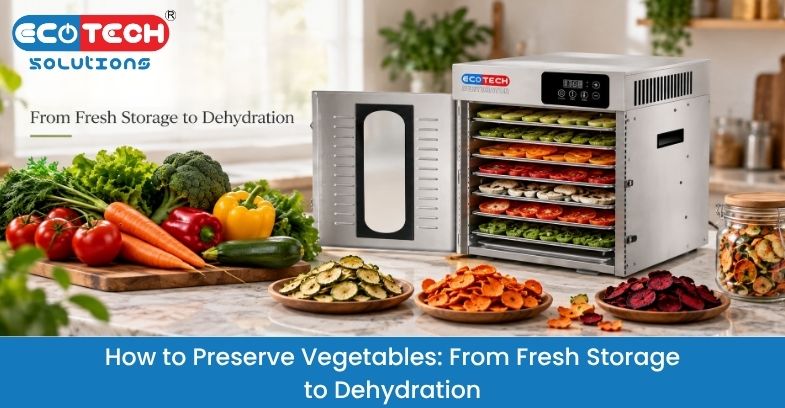
Fresh vegetables are an important part of a balanced diet, but many varieties have a relatively short shelf life. Temperature, humidity, exposure to air, and improper storage can cause vegetables to lose their freshness, texture, flavor, and nutritional quality. Learning how to preserve vegetables properly can help reduce food waste, extend storage life, and make seasonal produce available for longer periods.
There are several ways to store and preserve vegetables, ranging from simple refrigeration and proper packaging to freezing, pickling, and drying. Choosing the right method depends on the type of vegetable, the desired storage period, available equipment, and how the vegetables will be used later.
For households, restaurants, food businesses, and commercial food processors, understanding different vegetable preservation methods can make food storage more practical and efficient. One increasingly useful option is dehydration, which removes moisture from vegetables and helps create products that can be stored for extended periods when properly packaged.
Why Is Vegetable Preservation Important?
Vegetables naturally contain a significant amount of water. This moisture supports freshness but can also encourage microbial growth and quality deterioration when vegetables are stored under unsuitable conditions.
Preservation helps slow down these processes. Proper storage can:
- Extend the usable life of vegetables
- Reduce household and commercial food waste
- Help preserve seasonal produce
- Make vegetables easier to transport and store
- Provide convenient ingredients throughout the year
- Support food businesses that need longer-lasting ingredients
Knowing how to preserve vegetables also allows you to select the appropriate preservation technique instead of relying on one method for every type of produce.
For example, leafy greens generally require different storage conditions than root vegetables. Similarly, vegetables intended for long-term storage may benefit from freezing or dehydration rather than simple refrigeration.
How to Preserve Fresh Vegetables in the Refrigerator
Refrigeration is one of the simplest preservation techniques for many fresh vegetables. However, simply placing every vegetable inside the refrigerator is not always the best approach.
Understanding how to preserve fresh vegetables starts with knowing the storage requirements of different varieties.
1. Clean and Sort Vegetables
Before storing vegetables, inspect them carefully and remove damaged or spoiled pieces. One deteriorating vegetable can affect nearby produce, particularly when vegetables are packed closely together.
Avoid washing vegetables too far in advance unless they are going to be used immediately. Excess surface moisture can contribute to faster deterioration for certain vegetables.
2. Use Appropriate Containers
Storage containers, breathable bags, perforated produce bags, or suitable food-grade packaging can help control moisture and airflow.
Leafy vegetables may benefit from breathable storage that prevents excessive condensation, while some vegetables require more protection from moisture loss.
3. Separate Different Types of Produce
Different vegetables have different storage requirements. Keep vegetables organized according to their needs rather than placing everything together.
For example, leafy greens, root vegetables, and vegetables with higher moisture content may require different packaging or storage conditions.
4. Control Temperature and Humidity
Temperature and humidity play important roles in vegetable storage. A refrigerator can slow down deterioration, but excessively cold or unsuitable conditions may negatively affect some vegetables.
When considering how to preserve fresh vegetables, always consider the specific storage requirements of the vegetable rather than applying one universal method.
Freezing as a Vegetable Preservation Method
Freezing is another popular approach for extending vegetable shelf life. It can be especially useful when you have more vegetables than you can consume within a few days.
Many vegetables are commonly blanched before freezing. Blanching involves briefly heating vegetables and then cooling them rapidly. This process can help maintain quality during frozen storage.
After preparation, vegetables should be drained properly, packed in suitable freezer-safe packaging, and labeled with the storage date.
Freezing is convenient, but it requires continuous access to a freezer and sufficient storage space. Texture can also change after thawing, so frozen vegetables may be more suitable for soups, curries, sauces, and cooked dishes than for recipes requiring crisp fresh vegetables.
Pickling and Other Preservation Techniques
Pickling is a traditional preservation technique that uses an acidic or salty environment to create conditions that help extend storage life. Depending on the recipe and preservation process, vegetables such as cucumbers, carrots, onions, and peppers can be pickled.
Other traditional techniques include fermentation and salt-based preservation. These methods can provide distinctive flavors while extending the usability of certain vegetables.
However, preservation methods should be selected carefully because food safety depends on using appropriate ingredients, processing conditions, containers, and storage practices.
Vegetable Dehydration for Long-Term Storage
One of the most useful techniques for extending vegetable shelf life is vegetable dehydration. Unlike refrigeration, dehydration focuses on reducing the moisture available in the vegetables.
When vegetables are properly dried, their reduced moisture content can make them easier to store and transport. Dried vegetables can later be used in soups, sauces, instant meals, seasoning blends, snack products, and other food applications.
What Is Vegetable Dehydration?
Vegetable dehydration is a food preservation process in which moisture is removed from vegetables under controlled drying conditions.
The vegetables are typically cleaned, prepared into suitable pieces, and exposed to warm, moving air. The drying process gradually removes moisture while aiming to maintain desirable characteristics such as color, flavor, and overall quality.
The exact drying time and temperature depend on factors such as:
- Vegetable type
- Slice thickness
- Initial moisture content
- Drying temperature
- Air circulation
- Loading quantity
- Desired final moisture level
Because vegetables differ considerably, drying conditions should be adjusted according to the specific product.
How to Preserve Vegetables Through Dehydration
If you are researching how to preserve vegetables for extended periods, dehydration can be an effective option when performed correctly.
Step 1: Select Fresh Vegetables
Start with fresh, good-quality vegetables. Remove vegetables that show signs of spoilage, mold, or significant damage.
Fresh produce generally provides better results than vegetables that are already deteriorating.
Step 2: Wash and Prepare
Wash vegetables thoroughly and remove unwanted parts. Depending on the vegetable, you may need to peel, trim, slice, or cut it into smaller pieces.
Uniform pieces are helpful because they allow moisture to leave the vegetables more consistently during drying.
Step 3: Consider Pre-Treatment
Some vegetables may benefit from pre-treatment such as blanching before drying. The appropriate treatment depends on the vegetable and the desired final product.
Pre-treatment can influence color, texture, and overall quality during storage.
Step 4: Arrange Vegetables Properly
Place prepared vegetables in a single, suitable layer with sufficient space for air movement. Overloading trays can restrict airflow and result in uneven drying.
For commercial operations, proper tray loading becomes particularly important because large quantities need consistent exposure to controlled airflow.
Step 5: Dry Under Controlled Conditions
During vegetable dehydration, warm air passes around the vegetables and gradually removes moisture.
Controlled drying equipment can provide more consistent conditions than uncontrolled outdoor drying, particularly when businesses need repeatable results.
Step 6: Cool and Package
After drying, allow the vegetables to cool before packaging. Packaging warm dried vegetables can create condensation, which may affect storage quality.
Use appropriate moisture-resistant, food-safe packaging and store the finished product in a cool, dry location.
Using a Food Dehydrator for Vegetable Preservation
For people or businesses interested in consistent drying, a dedicated dehydrator can provide controlled airflow and temperature.
For smaller-scale applications, a 6 Tray electrical Food dehydrator can be considered for drying vegetables and other food products.
For larger-scale operations, equipment designed for higher capacity can make the drying process more practical. A 192 Trays Heat pump dehydrator is designed for applications where larger quantities need to be processed.
A dedicated Vegetable Dryer Machine can also be relevant for businesses looking for equipment specifically designed around vegetable drying applications.
The appropriate equipment depends on production volume, available space, vegetable type, desired drying characteristics, and operational requirements.
How to Preserve Fresh Vegetables Without Reducing Quality
When learning how to preserve fresh vegetables, the goal should not simply be to extend storage time. Maintaining quality is equally important.
Here are some practical considerations:
- Avoid Excess Moisture
Excess moisture can accelerate deterioration in many fresh vegetables. Use suitable packaging and avoid storing wet vegetables without proper airflow.
- Maintain Appropriate Storage Conditions
Temperature, humidity, and ventilation should match the requirements of the specific vegetable.
- Avoid Overcrowding
Crowded storage can restrict airflow and may allow deterioration to spread more quickly between vegetables.
- Inspect Stored Produce Regularly
Check vegetables periodically and remove damaged or spoiled pieces. This simple practice can help protect the remaining produce.
- Use the Right Preservation Method
Different vegetables respond differently to refrigeration, freezing, pickling, and drying. Choosing an appropriate method is one of the most important vegetable preservation methods for maintaining quality.
Fresh Storage vs. Dehydration
Fresh storage and dehydration serve different purposes.
| Feature | Fresh Storage | Dehydration |
| Storage condition | Usually refrigerated | Dry, controlled storage |
| Moisture | High | Significantly reduced |
| Storage space | Relatively larger | Reduced product volume |
| Preparation | Minimal | Requires processing |
| Typical use | Fresh cooking | Soups, sauces, meals, snacks |
| Equipment | Refrigerator | Dehydrator or dryer |
| Long-term storage | Limited | Can be extended with proper processing and packaging |
Fresh storage is generally convenient for short-term use, while dehydration can be useful when the objective is longer storage and reduced product volume.
Choosing the Right Vegetable Preservation Method
The best preservation approach depends on your specific needs. Refrigeration is convenient for short-term storage. Freezing can provide longer storage while retaining many characteristics of the original vegetable. Pickling and fermentation can provide distinctive preserved products.
Dehydration is particularly useful when reducing moisture and creating shelf-stable dried ingredients is the objective.
For commercial food processors, selecting the right drying equipment can also affect production consistency and efficiency. Companies researching industrial food-processing solutions can explore Heat Pump Manufacturer options and compare equipment according to their processing requirements.
Common Mistakes to Avoid
Even simple preservation techniques can fail when basic storage principles are overlooked.
Common mistakes include:
- Storing spoiled vegetables with fresh produce
- Using unsuitable packaging
- Allowing excessive moisture to accumulate
- Overcrowding storage containers
- Cutting vegetables into inconsistent sizes before drying
- Overloading dehydrator trays
- Packaging dried vegetables before they have cooled
- Storing dried products in unsuitable conditions
Avoiding these mistakes can improve the overall results of different vegetable preservation methods.
Final Thoughts
Understanding how to preserve vegetables can help households and food businesses reduce waste, extend the usefulness of seasonal produce, and maintain a convenient supply of ingredients. Refrigeration, freezing, pickling, and drying all have a place in food preservation, but the right method depends on the type of vegetable and the intended storage period.
For short-term needs, proper refrigeration and packaging may be sufficient. For longer storage, freezing, pickling, or dehydration may provide additional options.
Among the available techniques, vegetable dehydration offers an effective way to reduce moisture and create dried vegetables that are easier to store and transport. With suitable preparation, controlled drying, proper cooling, and appropriate packaging, dehydrated vegetables can become useful ingredients for a variety of food applications.
Whether you are preserving vegetables at home or processing them on a commercial scale, understanding how to preserve fresh vegetables and selecting the appropriate preservation technique can help improve storage efficiency while reducing unnecessary food waste.
Contact Us: EcoTech Solutions