
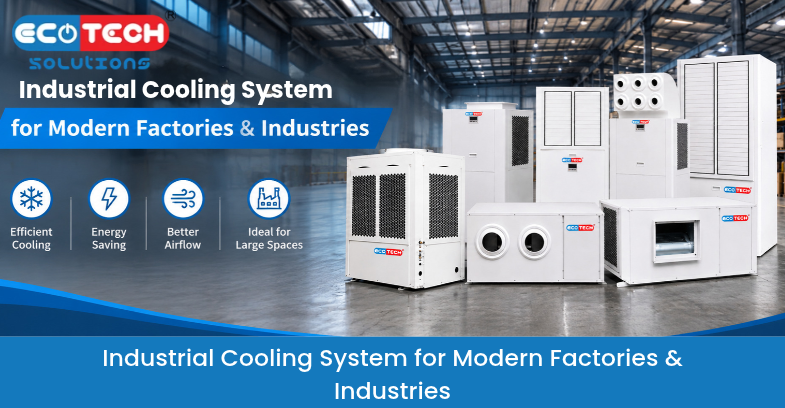
Modern factories and industrial facilities generate significant heat through machinery, production processes, lighting, and continuous operations. When indoor temperatures become uncomfortable, they can affect employee comfort, equipment performance, product quality, and daily productivity. Choosing the right cooling setup is therefore an important part of creating a safer, more efficient, and comfortable working environment.
Industrial facilities have different cooling requirements depending on their building size, ceiling height, machinery, ventilation, number of workers, and operating hours. A small workshop may need targeted cooling, while a large manufacturing plant or warehouse may require a carefully planned combination of air movement, ventilation, and cooling equipment.
ET Solutions provides industrial and commercial cooling equipment designed for demanding environments. Businesses can explore suitable technologies and compare options according to their site conditions, cooling objectives, and energy requirements.
Why Do Modern Factories Need an Effective Cooling System?
Heat is a common challenge in manufacturing units, fabrication workshops, warehouses, textile facilities, automotive plants, and processing areas. Machinery releases heat during operation, while roofs and walls can absorb solar radiation and increase indoor temperatures. In facilities with limited ventilation, hot air may remain trapped for long periods.
A properly selected cooling setup can help manage these conditions by improving air circulation and reducing excessive heat in occupied areas. Better thermal comfort may also help employees remain focused during physically demanding tasks.
An effective Industrial cooling system can support several operational goals:
- Improved employee comfort: Reducing uncomfortable heat can create a more suitable workplace.
- Better air circulation: Planned airflow helps reduce stagnant and stuffy areas.
- Equipment support: Appropriate temperature management can help protect heat-sensitive equipment, subject to its operating specifications.
- Process stability: Some manufacturing activities require controlled environmental conditions.
- Operational efficiency: Selecting equipment according to actual cooling needs can help avoid unnecessary energy use.
Cooling requirements should always be assessed according to the process, building layout, local climate, and applicable workplace standards. Equipment should be selected only after these site conditions have been reviewed.
Types of Industrial Cooling Systems Used in Factories
There is no single cooling technology that suits every industrial building. The right choice depends on the heat load, required temperature, humidity conditions, fresh-air needs, and available installation space.
1. Evaporative Cooling Systems
An evaporative cooling system uses the natural process of water evaporation to reduce the temperature of incoming air. In a typical direct arrangement, warm outdoor air passes through wetted cooling pads. As some of the water evaporates, it absorbs heat from the air, and the resulting cooler air is supplied to the occupied space.
These systems are often considered for factories, workshops, warehouses, and other large areas where fresh-air circulation is important. Their suitability depends strongly on outdoor humidity and the building’s ability to exhaust air.
Potential advantages include:
- Fresh outdoor air supply
- High-volume air movement
- Relatively simple operating principles
- Potentially lower energy use than conventional refrigerant-based cooling in suitable climates
- Applications in large, open industrial spaces
Direct evaporative cooling adds moisture to the supply air. Therefore, humidity-sensitive processes or already humid climates may require a different approach, such as indirect or hybrid cooling. Proper exhaust ventilation and water-system maintenance are also important.
2. Industrial Air Conditioning
Conventional air conditioning uses a refrigeration cycle to remove heat from indoor air. It may be suitable where businesses need closer temperature control, cooling for enclosed areas, or specific environmental conditions.
An industrial air cooling system may be designed around packaged units, split systems, ducted equipment, or other configurations. The correct arrangement depends on the cooling load, space layout, operating conditions, and required air distribution.
Industrial air conditioning can be useful for control rooms, offices within factories, laboratories, and production areas that need more precise temperature management. Equipment capacity and installation design should be evaluated by qualified professionals.
3. Ventilation and Exhaust Cooling
Ventilation systems remove hot, stale, or contaminated air and help introduce fresh air into a building. Exhaust fans, roof ventilators, wall-mounted fans, and planned air inlets can support heat removal and improve air movement.
Ventilation alone may not provide sufficient temperature reduction in every facility, but it can be an important part of a complete cooling strategy. It is especially relevant where machinery, furnaces, or production activities release heat into the workspace.
4. Hybrid Cooling Solutions
Hybrid systems combine two or more technologies, such as mechanical refrigeration, evaporative pre-cooling, and ventilation. They may be considered when a facility needs a balance of temperature control, fresh air, and operating efficiency.
The design should account for seasonal weather, indoor humidity, process requirements, and the expected operating schedule. A site assessment can help determine whether a hybrid arrangement is more suitable than a single cooling technology.
How to Choose the Right Industrial Cooling Solution
Selecting equipment based only on floor area can lead to poor results. A reliable selection process considers the heat generated inside the facility as well as the heat entering from outside.
Before choosing an Industrial cooling solution, businesses should evaluate the following factors:
1. Building Size and Layout
Measure the total floor area, ceiling height, roof construction, and internal partitions. Tall buildings and open production halls may require different air distribution arrangements from smaller enclosed rooms.
2. Heat Load and Machinery
Identify heat-producing equipment, production lines, ovens, compressors, motors, and other sources. The number of machines, their operating hours, and their heat output all influence cooling requirements.
3. Local Climate and Humidity
Outdoor temperature and humidity affect the performance of different cooling technologies. Evaporative cooling is generally more suitable in hot, relatively dry conditions. In humid environments, its cooling potential may be reduced, so other technologies may need to be considered.
4. Airflow and Ventilation
An industrial air cooling system must deliver air where it is needed. Review air inlets, exhaust points, obstructions, and areas where heat accumulates. Correct airflow planning helps avoid uneven cooling.
5. Energy and Maintenance Requirements
Compare expected electricity consumption, water use where applicable, filter or pad replacement, cleaning needs, service access, and equipment lifespan. Consider the total cost of ownership rather than only the initial purchase price.
Benefits of Installing a Suitable Industrial Air Cooling System
A well-planned industrial air cooling system can contribute to a more comfortable and functional workplace. The benefits depend on the technology selected and how well it is matched to the facility.
1. Improved Workplace Comfort
Excessive heat can make physical work more difficult. Appropriate cooling and ventilation can help create more comfortable conditions for employees in production and storage areas.
2. Better Air Movement
Large industrial spaces can develop hot spots and stagnant zones. Correctly positioned equipment, supply outlets, and exhaust systems can improve air circulation.
3. Support for Equipment Operating Conditions
Some machines and electronic components have specified temperature limits. Maintaining suitable environmental conditions can help businesses operate equipment within manufacturer recommendations.
4. Flexible Industrial Applications
Different cooling technologies can be selected for factories, warehouses, workshops, assembly lines, and selected process areas. Some facilities may benefit from separate cooling zones rather than cooling the entire building in the same way.
5. More Informed Energy Planning
Matching equipment capacity to the actual load helps avoid oversizing or undersizing. In suitable conditions, evaporative options may offer an alternative to cooling every large space with conventional air conditioning.
Businesses looking for suitable equipment can explore the Industrial Air Conditioner range from ET Solutions for industrial and commercial cooling applications. The right selection depends on building dimensions, cooling requirements, and operating conditions.
Applications Across Different Industries
Industrial cooling is relevant to a wide range of business environments. However, each industry has different temperature, humidity, hygiene, and ventilation requirements.
- Manufacturing plants: Cooling and ventilation can help manage heat from production machinery and assembly operations.
- Warehouses and logistics centres: Air movement and suitable cooling can improve conditions in large storage and dispatch areas.
- Automotive facilities: Workshops and manufacturing areas may need cooling around machinery, workstations, and assembly lines.
- Textile units: Cooling and humidity conditions should be considered together because they can influence materials and production processes.
- Food processing facilities: Temperature, humidity, hygiene, and air quality requirements must be assessed carefully for each process.
- Engineering workshops: Ventilation and cooling can help manage heat from equipment and physically demanding work.
For large factories, warehouses, and manufacturing facilities, evaporative technology may be an option where outdoor humidity and ventilation conditions are suitable. Businesses can explore the Evaporative Industrial Air Conditioner from ET Solutions for industrial cooling applications.
For areas with strict temperature or humidity requirements, businesses should consult an HVAC professional and follow the relevant process and safety standards.
Why Work with Experienced Industrial Cooling System Manufacturers?
Choosing equipment is only one part of a successful project. System design, capacity selection, installation quality, commissioning, and ongoing maintenance all influence performance.
When comparing industrial cooling system manufacturers, businesses should review:
- Experience with similar industrial applications
- Available cooling technologies and equipment configurations
- Technical details such as airflow, capacity, and power requirements
- Support with site assessment and system selection
- Installation, commissioning, and service arrangements
- Availability of spare parts and maintenance guidance
- Warranty terms and documentation
Ask for technical information that matches the actual project rather than relying only on broad performance claims. Experienced industrial cooling system manufacturers should be able to explain the operating conditions, limitations, and maintenance requirements of the proposed equipment.
Selecting an experienced equipment supplier is also important when planning industrial heating and cooling projects. Visit ET Solutions – Heat Pump Manufacturer to explore its range of heat pump products and industrial equipment solutions.
Conclusion
Choosing the right cooling approach is an important decision for modern factories and industrial facilities. Building size, machinery heat, outdoor climate, humidity, ventilation, and process requirements all influence system performance. Evaporative cooling, conventional air conditioning, ventilation, and hybrid technologies each have applications where they may be suitable.
A properly assessed Industrial cooling system can help improve workplace comfort, support equipment operating conditions, and create better airflow throughout a facility. Businesses should compare technical specifications, installation requirements, maintenance needs, and long-term operating costs before making a decision.
Explore the industrial cooling products available from ET Solutions and discuss your facility’s requirements to identify a suitable option for your operation.
Frequently Asked Questions (FAQs)
1. What is an industrial cooling system?
It is equipment designed to manage heat and maintain suitable temperatures in factories, warehouses, and industrial facilities.
2. Which cooling system is best for factories?
It depends on building size, heat load, humidity, ventilation, and operating requirements.
3. How does evaporative cooling work?
It uses water evaporation to reduce incoming air temperature and circulate cooler air.
4. Is industrial evaporative cooling energy efficient?
It can consume less electricity than conventional air conditioning in suitable climate conditions.
5. Which industries need industrial cooling?
Manufacturing, textile, automotive, food processing, engineering, and warehousing industries commonly require cooling.
6. How do I choose industrial cooling equipment?
Consider cooling capacity, airflow, energy consumption, building dimensions, installation, and maintenance.
7. How often should cooling equipment be maintained?
Follow the manufacturer’s maintenance schedule and inspect filters, fans, pumps, and cooling components regularly.
Contact Us: EcoTech Solutions