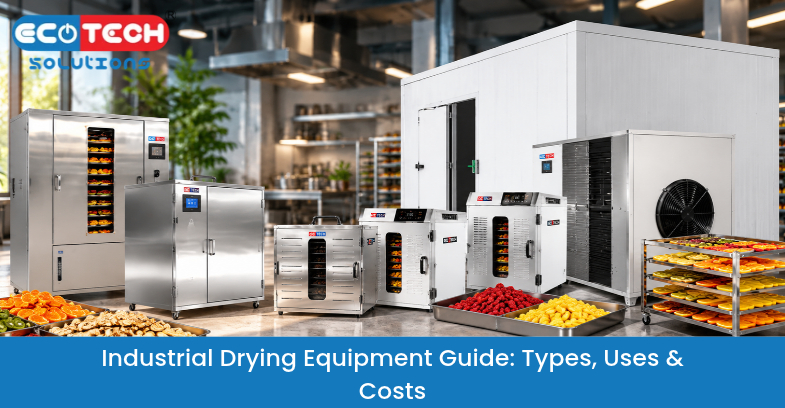
Industrial drying plays an important role in food processing, agriculture, pharmaceuticals, chemicals, and manufacturing. Businesses use drying technology to remove moisture from products, improve shelf life, maintain product quality, and make storage and transportation easier. Choosing the right equipment can help manufacturers improve production efficiency, reduce material waste, and manage operating costs.
However, selecting suitable machinery requires more than comparing purchase prices. Businesses must consider the type of material being processed, moisture content, production capacity, energy consumption, drying temperature, and product quality requirements.
This guide explains the different types of industrial drying equipment, their applications, estimated cost factors, and the key considerations businesses should evaluate before investing in a drying solution.
What Is Industrial Drying Equipment?
Industrial drying equipment refers to machinery designed to remove moisture from raw materials, food products, agricultural produce, chemicals, and other industrial materials. The process generally uses heat, airflow, vacuum conditions, or other drying technologies to evaporate or remove moisture from a product.
The primary objective is to achieve the required moisture level without compromising the material’s quality, texture, appearance, or functional properties.
For example, food manufacturers use drying technology to process fruits, vegetables, herbs, spices, and other ingredients. Agricultural businesses use it to reduce moisture in crops, while industrial manufacturers may require drying solutions for powders, granules, and specialized materials.
Modern industrial drying equipment is available in different configurations to suit small processing facilities, commercial production units, and large-scale manufacturing plants.
The appropriate solution depends on the product being dried, the required output, and the operating conditions of the facility.
Why Is Industrial Drying Important?
Drying is an essential processing step for businesses that need consistent product quality and reliable storage conditions.
1. Extends Product Shelf Life
Removing excess moisture can help reduce microbial growth and slow certain deterioration processes. In food processing, achieving a suitable final moisture level is important for maintaining product stability during storage.
However, drying alone does not guarantee food safety. Proper temperature control, hygienic handling, packaging, and storage are also necessary.
2. Improves Storage and Transportation
Products with lower moisture content may be easier to store, package, and transport. Dried foods and agricultural materials can also require less storage space depending on their form and packaging.
3. Supports Consistent Product Quality
Controlled drying helps businesses maintain more consistent moisture levels, colour, texture, and other product characteristics.
4. Reduces Material Waste
Suitable drying methods can help processors preserve usable materials that might otherwise deteriorate quickly because of excessive moisture.
5. Improves Production Efficiency
Automated drying processes can reduce manual handling and help manufacturers achieve more predictable production cycles.
For these reasons, businesses should evaluate industrial drying equipment according to their production requirements rather than selecting machinery based on price alone.
Types of Industrial Drying Equipment
Different drying technologies are designed for different materials, production capacities, and moisture-removal requirements. Understanding their differences can help businesses identify an appropriate solution.
1. Tray Dryers
Tray dryers are commonly used for drying food products, herbs, spices, agricultural materials, and certain industrial ingredients.
Materials are placed on trays inside an enclosed chamber. Heated air circulates around the trays, allowing moisture to evaporate from the product.
Key features:
- Suitable for batch processing.
- Relatively straightforward operation.
- Adjustable drying temperatures on suitable models.
- Useful for small and medium production operations.
- Flexible for processing different products.
Tray dryers may be suitable for businesses processing sliced fruits, vegetables, herbs, or other products in batches. Actual drying time depends on product thickness, initial moisture, airflow, loading density, and temperature.
2. Heat Pump Dryers
Heat pump drying technology uses a refrigeration cycle to transfer heat and manage moisture removal from circulating air. Depending on the system design, it can provide controlled drying conditions at comparatively low temperatures.
This technology may be useful when businesses need to preserve the colour, aroma, texture, or other quality characteristics of temperature-sensitive materials.
Potential applications include:
- Fruits and vegetables.
- Herbs and spices.
- Mushrooms.
- Certain agricultural products.
- Selected food ingredients.
A heat pump dryer can be particularly worth evaluating when energy efficiency and control over drying conditions are important.
Explore the HEAT PUMP FOOD DEHYDRATOR to learn more about this type of drying solution.
3. Electrical Dehydrators
Electrical dehydrators use electrically powered heating elements or an electrically driven heating system to provide the energy required for moisture removal. Air circulation distributes heat throughout the drying chamber.
These machines can be useful for food processors and manufacturers that require controlled batch drying.
Typical applications include:
- Fruit slices.
- Vegetable pieces.
- Herbs.
- Spices.
- Other suitable food products.
When comparing electrical models, consider the connected electrical load, operating hours, drying capacity, airflow design, and the cost of electricity at your facility.
Businesses evaluating this technology can explore the Electrical Dehydrator offered by ET Solutions.
4. Spray Dryers
Spray dryers convert liquid feeds, such as solutions, suspensions, or emulsions, into powders by dispersing the feed into small droplets and exposing them to a stream of hot drying gas.
They are widely used in industries that need powdered products.
Common applications include:
- Dairy ingredients.
- Food flavourings.
- Certain pharmaceutical products.
- Chemical powders.
- Selected nutritional ingredients.
Spray drying generally involves a more complex installation than basic batch drying. The design must account for feed properties, powder characteristics, production capacity, and applicable safety requirements.
5. Rotary Dryers
Rotary dryers use a rotating cylindrical drum to move material through a heated drying zone. They are commonly associated with industrial and bulk-material processing.
Potential applications include:
- Minerals.
- Selected agricultural materials.
- Industrial granules.
- Certain chemical materials.
- Other bulk solids compatible with the process.
These systems are often considered when businesses require continuous or high-throughput processing. Equipment selection depends on material properties, throughput, moisture reduction requirements, and the characteristics of the heat source.
6. Vacuum Dryers
Vacuum dryers remove moisture under reduced pressure. Because water can evaporate at lower temperatures under vacuum conditions, this method may be appropriate for certain heat-sensitive products.
Applications can include specialized food ingredients, pharmaceutical materials, chemicals, and other products requiring carefully controlled processing.
Vacuum drying systems may involve higher initial investment and additional maintenance considerations because of their pressure-control equipment and associated components.
7. Fluidized Bed Dryers
Fluidized bed dryers pass air through a bed of suitable particles at a velocity that suspends or fluidizes them. This creates substantial contact between the drying air and the material.
They are used for suitable powders, granules, and particulate materials in food, pharmaceutical, and chemical manufacturing.
The technology can support efficient heat and mass transfer, but the material must have properties compatible with fluidization.
Common Applications of Industrial Drying Systems
The design and operating requirements of industrial drying systems vary significantly across industries.
Food Processing
Food manufacturers use drying to process fruits, vegetables, herbs, spices, and other ingredients. Properly controlled drying can help improve storage stability and support the production of convenient food products.
For commercial food processors, an Industrial Food Dehydrator Machine may be worth evaluating based on the product range and required production output.
Agriculture
Agricultural businesses use drying processes to reduce excess moisture in suitable crops and plant materials. The appropriate drying method depends on the crop, initial moisture content, weather conditions, and required storage standards.
Pharmaceuticals
Pharmaceutical manufacturing may require carefully controlled moisture removal to achieve specified product characteristics. Equipment must be selected according to the material, process validation requirements, and applicable regulations.
Chemical Manufacturing
Chemical manufacturers may use dryers to process powders, crystals, granules, and other materials. Temperature sensitivity, chemical compatibility, dust control, and process safety are important selection factors.
Nutraceuticals and Herbal Products
Selected herbal ingredients and nutraceutical materials require controlled drying to help preserve important quality characteristics. The required process depends on the material and the specifications of the finished product.
How Much Does Industrial Drying Equipment Cost?
The cost of industrial drying equipment varies considerably depending on the drying technology, production capacity, construction materials, automation level, and installation requirements.
There is no single price that applies to every application. A compact batch dryer and a large continuous industrial system may have very different purchase and operating costs.
The following factors influence the overall investment.
1. Production Capacity
Capacity is one of the most important pricing factors.
A machine designed to process small batches may require less equipment and infrastructure than a system intended for continuous, high-volume production.
When requesting a quotation, clarify whether capacity is specified as:
- Kilograms of fresh material per batch.
- Kilograms of dried product per batch.
- Kilograms per hour.
- Kilograms per day.
These measurements are not interchangeable. Fresh-material input and finished-product output can differ significantly because moisture is removed during processing.
2. Drying Technology
Different technologies involve different components and engineering requirements.
For example, a basic electrical dryer may have a different cost structure from a heat pump dryer, spray dryer, rotary dryer, or vacuum drying system.
The best choice depends on the product, production volume, drying temperature, and required final moisture level.
3. Construction Materials
Food-processing applications may require stainless steel contact surfaces and hygienic construction.
The required grade of stainless steel, chamber design, insulation, tray configuration, and surface finish can influence the final quotation.
4. Energy Consumption
Purchase price is only one part of the total cost of ownership.
Electricity consumption, operating hours, maintenance requirements, labour, and production downtime all affect long-term expenses.
Businesses should request information about expected energy consumption under specified operating conditions rather than comparing machines solely by their rated capacity.
5. Automation and Controls
Advanced controls may provide programmable temperature settings, humidity management, airflow adjustments, monitoring, and automated operating sequences.
These features can help improve repeatability and reduce manual intervention, although the benefits depend on the production process and how the equipment is operated.
6. Installation and Supporting Infrastructure
The final investment may also include electrical connections, ventilation, exhaust arrangements, civil work, installation, commissioning, and operator training.
Depending on the application, businesses may also need additional processing, material-handling, or packaging equipment.
How to obtain an accurate price: Share the product to be dried, the required input capacity, initial and target moisture levels, preferred drying temperature, operating hours, and installation location with the equipment supplier. These details help the supplier recommend a suitable configuration and prepare a more meaningful quotation.
Industrial Dehydration Equipment: How to Choose the Right Solution
Selecting suitable industrial dehydration equipment requires a clear understanding of the material and the production process.
Use the following checklist before making a purchase.
- Identify the Material
Determine whether you need to dry fruit, vegetables, herbs, spices, powders, granules, or another material.
Different products behave differently during drying. A solution designed for one material may not produce satisfactory results with another.
- Define the Required Capacity
Estimate the amount of fresh material you need to process per batch, hour, or day.
Allow for seasonal fluctuations and expected future production growth.
- Establish the Target Moisture Level
Identify the initial moisture content and the desired final moisture content. This information helps determine the moisture-removal load and expected processing requirements.
- Evaluate Temperature Requirements
Some products tolerate higher temperatures, while others require gentler processing to preserve quality.
Choose a technology that can achieve the desired result without unacceptable damage to the product.
- Compare Energy Performance
Ask suppliers for expected electricity consumption, operating conditions, and estimated drying time.
Where possible, compare energy use per kilogram of water removed or per kilogram of finished product. This provides a more useful comparison than looking at the connected electrical load alone.
- Consider Cleaning and Maintenance
Food-processing machinery should be designed to support appropriate cleaning and hygiene practices.
Check access to trays, filters, fans, seals, and other components that require routine inspection or cleaning.
- Request a Product Trial
When product quality is important, ask whether the supplier can conduct a trial using your actual raw material.
A trial can help assess drying time, finished-product quality, moisture uniformity, and practical production capacity.
Why Consider ET Solutions for Drying Equipment?
Businesses evaluating drying technology should work with a supplier that understands the requirements of their intended application.
ET Solutions provides product information about drying solutions, including electrical and heat pump dehydration options.
You can explore the following resources:
- Electrical Dehydrator for information about electrically powered dehydration equipment.
- HEAT PUMP FOOD DEHYDRATOR for information about heat pump drying technology.
- Industrial Food Dehydrator Machine for industrial food dehydration applications.
- ET Solutions — Heat Pump Manufacturer to explore the company’s website and available product information.
Before choosing a machine, discuss your product, batch size, required output, operating conditions, and budget with the supplier. Confirm the specifications and expected performance of the proposed equipment for your specific application.
Frequently Asked Questions
1. What is industrial drying equipment used for?
Industrial drying equipment removes excess moisture from food, agricultural products, chemicals, powders, and other materials. Businesses use it to improve storage stability, achieve consistent product specifications, and support manufacturing processes.
2. Which type of industrial dryer is best for food processing?
The best option depends on the food product, production capacity, desired moisture level, and quality requirements. Tray dryers, electrical dehydrators, and heat pump dryers may suit certain batch-processing applications, while spray dryers are used for suitable liquid feeds that need to be converted into powders.
3. What factors affect the cost of an industrial dryer machine?
Capacity, drying technology, construction materials, automation, energy consumption, installation, and maintenance requirements all affect the total investment. An accurate quotation requires details about the material and the intended production process.
4. Are heat pump dryers energy-efficient?
Heat pump dryers can offer energy-efficiency advantages in suitable applications because they transfer heat and can recover energy within the drying process. Actual performance depends on the system design, operating conditions, product, and required moisture removal.
5. How do I choose industrial dehydration equipment for my business?
Start by identifying the material, processing capacity, initial and target moisture levels, temperature requirements, and expected operating hours. Compare suitable technologies, review energy consumption and maintenance requirements, and consider conducting a product trial before purchasing.
Final Thoughts
Choosing the right drying technology is an important investment decision for food processors, agricultural businesses, and industrial manufacturers. The ideal solution should match the material being processed, production capacity, moisture-removal requirements, product quality expectations, and operating budget.
Before purchasing an industrial drying equipment solution, compare available technologies, evaluate energy consumption, review maintenance requirements, and obtain a quotation based on your actual processing needs. A well-matched drying system can support consistent production, improve moisture control, and help businesses manage long-term operating costs.
Contact Us: EcoTech Solutions